Things continue to go as expected, but Bangladesh none the less play better
My prediction of Steve Waugh's tactics turned out to be pretty much spot on. Australia did indeed declare about an hour after tea with a score of 400-450. (The score in fact was 407). However, the rest of day two turned out to be pretty good. Lehmann and Langer continued where they had left off the previous evening, and then batted for about another hour before Langer was out for 71. After than, Steve Waugh joined Lehmann, and Lehmann brought up his second test century before being out caught off Mashrafe Mortaza for 110. Martin Love then managed to get bowled first ball, again by Mashrafe Mortaza. This was no doubt a highlight for Mortaza and Bangladesh. After that Gilchrist joined Waugh and scored a quickfire 43 off 47 balls, before being bowled by Manjural Islam. Australia were 6/313 and had a good lead already, but the game was not as one sided as some people had predicted it would be. Bangladesh were taking wickets, and had some chance of bowling Australia out. However, Steve Waugh was still there, and he is an expert at extending the innings in these sorts of situations. Plus, Australia's tail can bat quite well, and as it happened Brett Lee (who scored 23) and Jason Gillespie (16 not out) had no trouble staying with Waugh.
Waugh brought up his century and immediately declared the innings closed, on 7/407, a first innings lead of 310. This was Waugh's 31st test century, which is a very impressive number by any standards. Given the difficulty he had scoring test centuries early in his career (and his associated tendency to get out in the 90s) the number really shows how well he has played over the last decade. The innings also made Waugh the first Australian to score test centuries against nine different opponents, and only the second player in the world (after Gary Kirsten of South Africa) to do this. Plus, it boosted Waugh's average back over the 50 mark, to 50.31. If Waugh wanted to retire now, that would look nice in the record books. (Of course, he has recently stated he wants to play for another year, and given his recent form he may well do so).
As far as the Australian innings is concerned, once again it's worth mentioning that it was the players who have not played every match over the last year who scored the runs: Langer, Waugh, Lehmann. Those who have suffered the year long grind (and who have undoubtedly spent the last month resting) were a little more subdued. (The exception to this rule is Love, who has played relatively few games for Australia but failed anyway). My suspicion is we may see more from Hayden, Ponting, and Gilchrist in the second test.
In any event, Bangladesh had to face 15 overs before the end of the day in their second innings. They lost Javed Omar to McGrath in the third over, and another collapse looked quite possible. However, it didn't happen. Hannan Sarkar and Habibul Bashar batted aggressively and well for the rest of the day, taking the score to 1/70 at stumps, a runrate of 4.67. Bangladesh are going to lose this game, but their aim must be to avoid an innings defeat. For this, they require another 240 runs. This is going to be hard, but hopefully they can give it a shot on day three.
Meanwhile, it has been confirmed that Sri Lanka will be playing Australia in Darwin and Cairns in a year's time. That should be fun. I must find an excuse to be there.
Saturday, July 19, 2003


I actually think that censoring things is generally more harmful to children than not censoring things

What rating is your journal?
brought to you by Quizilla
Actually, that quiz didn't seem to have a "most pictures I post are of non-human objects" page, unfortunately.
What rating is your journal?
brought to you by Quizilla
Actually, that quiz didn't seem to have a "most pictures I post are of non-human objects" page, unfortunately.
Friday, July 18, 2003
The expected happens
Day one of the Bangladesh v Australia test in Darwin went exactly as expected. That is, the game so far is a mismatch.
Australia won the toss and send Bangladesh in, and there is not a lot that can be said about their innings. The Australian bowlers were too good for them and they were bowled out for 97. As is almost always the case in this kind of mismatch, the bowling and the wickets were shared around. McGrath and Lee got three each, McGill and Gillespie two each. The score was perhaps reduced a little by an extremely slow outfield, and the pitch apparently wasn't the easiest ever seen, but I didn't see any of the cricket so I don't know the details.
Australia then batted, and they lost two wickets early: Hayden for 11 and Ponting for 10. However, Langer and Lehmann then stayed in, and at stumps the score was 2/121, with Lehmann on 51 and Langer on 40. Langer was lucky not to be run out at one point, but that is Langer for you. He is always lucky.
It was interesting (although perhaps not unexpected) that the two players who probably spent the most time in the middle during Australia's immense 10 month campaign (Hayden and Ponting) were out cheaply, and the test specialist (Langer) and middle order batsman who spent some of the campaign injured (Lehmann) scored the runs. It may be that these two actually did some practising before this match, whereas for Ponting and Hayden it was probably "A month off. Thank the Almighty for that".
It was also interesting that Australia scored runs at less than 3 an over (127 off 45, or 2.82). As mentioned above, the outfield was extremely slow and the pitch a little tricky, but the bowling was certainly nothing special. Australia like to score at least 100 runs a session: that normally corresponds to 3.33 runs an over. I think part of this may again be that the players are a bit underdone.
Where does the game go from here? Australia could probably finish the game on day 2 if they tried. They could take their score to 300 or so half an hour or so before tea, declare, and then have something like 45-50 overs to bowl Bangladesh out a second time, remembering that an extra 8 overs may be added to the day if "a result is imminent". However, I don't think they will. I am guessing Australia will bat until about an hour after tea, and score around 400-450 before the declaration. It all depends on how aggressive Steve Waugh wants to be, and whether he wants to give his batsmen (and himself) a longer chance to get some fairly easy runs.
Thursday, July 17, 2003
Redirection
I have a piece on stupid security checks and how to deal with them at The White Rose, and a few thoughts on the team selection for the first Australia v Bangladesh test at ubersportingpundit. I always find that there is something quite comforting about the Australian cricket team being in action, even in a minor series about this one. It just makes me feel that the world is a slightly better place. (Yes, I know this is silly).
I have a piece on stupid security checks and how to deal with them at The White Rose, and a few thoughts on the team selection for the first Australia v Bangladesh test at ubersportingpundit. I always find that there is something quite comforting about the Australian cricket team being in action, even in a minor series about this one. It just makes me feel that the world is a slightly better place. (Yes, I know this is silly).
Wednesday, July 16, 2003
More on Argentinian Malbec
For some reason when I talk about beer I seem to get more comments than when I talk about wine. I don't know why that is. In any event, in Sainsburys today I found another Argentinian Malbec, this one from Bodega Norton in Mendoza. The bottle has quite a fancy label of a couple dancing the tango, which appears to move when you look at it from a different direction, which would suggest to me that this winemaker is very keen on the idea of exports. This slightly frivolous touch was almost enough to put me off buying the wine, as they are clearly aiming at casual supermarket buyers rather than pretentious gits like myself.
However, I bought it anyway. Its was a five pound bottle of wine rather than a four pound bottle (as was the last one) and I think its slightly higher price was relected in the quality. Still not much of a nose (although what nose it had was a little like that of a merlot). Once again the wine was very young, vintage 2002, but was quite open and ready to drink. The wine was a little less jammy than the first one - the fruit was slightly more solid. Again, a good wine for the price, but not much complexity. I am still yet to be convinced that Argentinian Malbec is one of the great wines of the world, or the Malbec is a truly noble grape variety. Obviously, though, I shall be continuing the research.
Life near the singularity
From the BBC
The "main Magna building" sounds kind of ominous, too. (via slashdot).
From the BBC
Two airports have been alerted after a giant robotic balloon escaped from a science centre in South Yorkshire.
..
The flyborg has a computerised brain which allows it to avoid obstacles.
A spokesman for Magna said: "Two technical staff were moving a flyborg - an artificially intelligent flying robot airship filled with conventional party-balloon gas - into the main Magna building.
The "main Magna building" sounds kind of ominous, too. (via slashdot).
More thoughts on the Murray-Darling Basin, and whether Texas is part of the American West.
I have received quite a bit of feedback on yesterdays piece that started out being about Australian water resources and then rambled, in the form of comments, a post on another blog, and e-mail. There have been quite a few interesting points raised, and I think I am going to lose any sense that they are connected to each other People who want to see the connections should read the earlier post.
As a starting point, there is a very nice map of the Murray-Darling basin here. A key point is that much of the east coast of Australia consists of a relatively narrow coastal plane to the east of a mountain range (The Great Dividing Range). To the east of that mountain range, water comes down from the mountains onto the plain, and water is plentiful. Australia's three major non-marginal cities are on this plain (although only sort of for Melbourne). From a water resources point of view, there would be little difficulty building a substantial number of new cities on that coastal plain. To the north, the mountains eventually fade away, the climate becomes tropical, and once again there are plenty of areas (especially close to the north coast) where water is plentiful and which could support substantial populations, although at the moment they generally don't. The land within the Murray-Darling basin itself (and close to it) is habitable and useful as long as the river system remains in good condition. To the west of the basin, there are few rivers of any kind and the country is exceedingly harsh, although there are a few rivers and a small patch of moderately fertile land in the south of the west coast (a couple of thousand kilometres away), making the city of Perth possible. With respect to the Murray-Darling basin, the key point is that the watershed on the east of the basin is a watershed to a fertile area, and the watershed to the west is a watershed to desert. Human civilization (like Adelaide, if it qualifies) to the west of the basis very likely has to pump water from the basin.
The map shows the basic point, however. The Murray Darling basin is enormous. Adelaide gets its water from the very mouth of the river. If there are environmental problems upstream, then Adelaide is conceivably in trouble. However, despite its size, there are relatively few cities of any size in the Murray Darling basin. Australia's capital, Canberra (population approximately 300000) is the most important, followed by Albury Wodonga (100000) and Wagga Wagga (60000), but there really isn't much after that. Most water use is agricultural. Changing water would affect relatively few people, although those that would be forced to change are the sort that will scream very loudly. (It could conceivably change Australia's agricultural sector quite substantially, however).
Following up a different point from yesterday's article, Doug Sundseth of Colorado e-mails me to take slight issue with my discussing "the four American cities in the middle of the desert", arguing that Denver and Salt Lake City don't quite qualify as desert due to being at the foot of mountains and having a bit more rainfall than qualifies as desert. My experience of Denver is limited to changing planes at the airport, but it is clearly a different case geographically to the other cities, so I will concede the point there.
In the case of Salt Lake City I think I might argue that it actually is "in the middle of the desert" in the sense that there is desert in all directions, even if the place itself is not desert. The city was founded when after marching through very hostile country, the Mormons arrived in this beautiful (non-desert) location, decided it was fabulous, and announced that "This is the right place". Having been there, I have to concede that the city certainly is in a stunning location. (Might also I recommend the drive from Salt Lake City to Evanston, Wyoming to anyone who goes there. Really a spectacular drive). Doug also comments that El Paso, Texas / Juarez, Mexico certainly qualifies, and Tucson, Arizona perhaps does. I will plead guilty on El Paso omission. I was thinking of American cities in "The West", and Texas slipped my mind. When I divide America up into pieces, Texas doesn't really qualify as part of "The West", or "The South", or anywhere much. Texas is just Texas. (I haven't been to Texas, although I certainly plan to go there on my next trip to the US, whenever that is). As for Tucson, it is at least smaller than any of the other cities I have mentioned, so I can produce a logical reason for leaving it out.
In any event, none of this was really relevant to my argument, which was simply that America has large inland cities in even more marginal places than those I was talking about in Australia. A large portion of the Murray-Darling Basin is not desert, and that is the point.
Finally, Patrick commented that Darwin was not in fact named after Charles Darwin, but was named after his grandfather, Erasmus Darwin. This is reasonably widely believed in Australia - at least Patrick is not the first person to tell me this. However, the belief seems to be entirely untrue. The truth appears to be that after sailing Darwin after the world, the Beagle was then sailed to Australia. Its captain, Lieutenant John Lort Stokes, became the first person to name the geographical features in that part of Australia. He named the bay where the city now lies Port Darwin, and gulf surrounding it Beagle Gulf. When the city was founded at the location later, it was initially officially named Palmerston, at least partly because some people held Darwin's views to be controversial. However, the name officially became Darwin in 1911.
I think the mistaken belief that Darwin was named after Erasmus Darwin may come from the fact that most people expect that the area around Darwin must have been explored and named prior to 1830, and this coincides nicely with the fact that Erasmus Darwin was a prominent scientist around that time. However, it seems to be untrue.
Tuesday, July 15, 2003
Water resources, Australia's north, cricket, and what precisely is the point of Adelaide, anyway?
There is an article in the Economist this week talking about The Murray-Darling river system in Australia. (Sadly, it is behind a for-pay wall so I can't link to it. The gist of it is that Australians are overusing the water from the Murray-Darling river system. The mouth of the river has dried up for the second time in 215 years, and the salt levels of the whole river system is steadily increasing, and based on current trends the water will be undrinkable within 20 years. This is a problem, as the river's catchment area consists of a large chunk of four states, and is responsible for irrigating a large portion of the country's agriculture.
But it gets worse
The article goes on to say that Adelaide's problem is that it is at the end of the river, water rights are allocated on a state basis, and therefore people (mostly farmers) in three other states have essentially had a free for all with the water before it gets to South Australia. It may be that a constitutional amendment to transfer control of water rights to the federal government might be necessary to make sure that South Africa retains access to its water.
My gut feeling is that with or without this the situation will eventually be solved. The million people of Adelaide do have more economic power than a relatively small number of farmers in the other states, and ultimately the money of the people of Adelaide will make their interests the most important issue, and eventually the river will be cleaned up, even if it requires buying up a lot of farmland. There are cities in the world in more marginal places than Adelaide, and they survive. The Americans manage to have four major cities (Denver, Phoenix, Las Vegas and Salt Lake City) in the middle of the desert, and two even bigger cities (Los Angeles and San Diego) on the southern west coast. While water resources in the American west are greater than in Australia, the population of these areas in the US are greater by an even bigger factor, and the American cities survive, even if they are constantly squabbling over water.
However, this does of course raise an interesting question about the distribution of people in Australia. Of Australia's five main cities, two of them - Adelaide and Perth - are in very marginal locations. There is Adelaide, with the potentially severe water problems mentioned, and very desolate land if you drive very far out of the city in any direction. And there is Perth, which is on the relatively desolate West Coast. Perth is something of a boom town, due to the immense mineral wealth of the state of Western Australia. But Adelaide is a city that has probably seen better days. There is some industry there - a large portion of Australia's cars are made there - and the big growth industry is the wine industry. (Adelaide is surrounded by vineyards in all directions, essentially). But is this really enough to support a city of a million people? And why, of all the places in Australia they could be, are there a million people there precisely?
While a lot of Australia does consist of marginal and uninhabitable locations, there are actually plenty of fertile and uninhabited locations as well. The other three major cities, Melbourne, Sydney, and Brisbane, are in very non-marginal locations. As you go north from Melbourne through Sydney and Brisbane, the country generally becomes more fertile and the water resources greater. Once you get north of Brisbane, the country becomes more fertile still, and you eventually get to the tropical area and the north Queensland cities Cairns and Townsville (the home of Bubbles, Blossom, and Buttercup), and when you go west you eventually get to Darwin on the north coast.
These are all areas that could easily support large populations, but generally they don't. Traditionally people have avoided these sorts of areas because of the heat, but in these days of air conditioning this does not matter so much. (The American south has turned into a boom area since the invention of air conditioning for precisely this reason). Australia, bafflingly, has seriously trailed the United States in its use of air conditioning (particularly in people's homes) but we do seem to be finally getting there. And there is a gradual northern movement in the centre of Australia's population for this reason. Combined with this is the fact that the Asian economies to Australia's north have been becoming larger and steadily more important to us. This has led to more economic activity in the north, more Asian populations in the northern cities, and growth in these cities (particularly Cairns in Queensland) as tourist destinations.
In the long run, by which I mean 50 years or more, this inevitably will spell a profound change in the centre of gravity of Australia. Cities that are at present seen as very marginal to the country will become quite important. In the long run, there will probably be no better real estate investment than land in the centre of Darwin.
One way in which this present marginal status of the northern cities is reflected is in sporting terms. There are very few professional sporting teams based in the north because the cities are too small and the travel distances too great. None of the northern cities have first class cricket teams based there. People in the northern cities have had little chance to be spectators of top class sport.
However, this weekend the Australian cricket team will play Bangladesh in Darwin, and they will play them again in Cairns next week. A fair bit of the reason for this is that the Australian summer is crowded and the fixture list is long, to get the games in they have to be played out of season, and if they are played out of season the climate is not right in southern Australia at this time of year. This is perfectly true, but these games still represent a recognition that this region of Australia is slowly becoming less marginal. In 100 years, I cannot help but think that the Darwin test will be a very big occasion. So therefore, the first one, to be played this week, should be seen as a memorable occasion. I am sure the people of Darwin are seeing it this way, even though due to the weak opposition it shall probably not be very memorable as a game of cricket.
And just as an almost unrelated point, does anyone know of any city in the world other than Darwin that is named after a great scientist? The fact that we have one in Australia strikes me as extremely cool.
There is an article in the Economist this week talking about The Murray-Darling river system in Australia. (Sadly, it is behind a for-pay wall so I can't link to it. The gist of it is that Australians are overusing the water from the Murray-Darling river system. The mouth of the river has dried up for the second time in 215 years, and the salt levels of the whole river system is steadily increasing, and based on current trends the water will be undrinkable within 20 years. This is a problem, as the river's catchment area consists of a large chunk of four states, and is responsible for irrigating a large portion of the country's agriculture.
But it gets worse
South Australia, where until recently the Murray flowed into the Southern Ocean at Coorong, is the state at the end of the line. With little but desert and dry rivers to its north, Adelaide, the capital, depends entirely on water piped from the Murray more than 100km (60 miles) to the east. People in Coober Pedy, a mining town in the middle of desert, reckon their water, pumped and treated from ancient underground deposits, tastes better than Adelaide's. South Australia's minister for the Murray River, John Hill, says its rate of flow is half that needed to sustain it environmentally. From this month, irrigators in South Australia will have their water allocations cut by one-fifth; in October each state taxpayer will start paying a levy to raise A$20m ($13m) a year. The money will go towards buying extra water from upstream and projects to restore the flow.
The article goes on to say that Adelaide's problem is that it is at the end of the river, water rights are allocated on a state basis, and therefore people (mostly farmers) in three other states have essentially had a free for all with the water before it gets to South Australia. It may be that a constitutional amendment to transfer control of water rights to the federal government might be necessary to make sure that South Africa retains access to its water.
My gut feeling is that with or without this the situation will eventually be solved. The million people of Adelaide do have more economic power than a relatively small number of farmers in the other states, and ultimately the money of the people of Adelaide will make their interests the most important issue, and eventually the river will be cleaned up, even if it requires buying up a lot of farmland. There are cities in the world in more marginal places than Adelaide, and they survive. The Americans manage to have four major cities (Denver, Phoenix, Las Vegas and Salt Lake City) in the middle of the desert, and two even bigger cities (Los Angeles and San Diego) on the southern west coast. While water resources in the American west are greater than in Australia, the population of these areas in the US are greater by an even bigger factor, and the American cities survive, even if they are constantly squabbling over water.
However, this does of course raise an interesting question about the distribution of people in Australia. Of Australia's five main cities, two of them - Adelaide and Perth - are in very marginal locations. There is Adelaide, with the potentially severe water problems mentioned, and very desolate land if you drive very far out of the city in any direction. And there is Perth, which is on the relatively desolate West Coast. Perth is something of a boom town, due to the immense mineral wealth of the state of Western Australia. But Adelaide is a city that has probably seen better days. There is some industry there - a large portion of Australia's cars are made there - and the big growth industry is the wine industry. (Adelaide is surrounded by vineyards in all directions, essentially). But is this really enough to support a city of a million people? And why, of all the places in Australia they could be, are there a million people there precisely?
While a lot of Australia does consist of marginal and uninhabitable locations, there are actually plenty of fertile and uninhabited locations as well. The other three major cities, Melbourne, Sydney, and Brisbane, are in very non-marginal locations. As you go north from Melbourne through Sydney and Brisbane, the country generally becomes more fertile and the water resources greater. Once you get north of Brisbane, the country becomes more fertile still, and you eventually get to the tropical area and the north Queensland cities Cairns and Townsville (the home of Bubbles, Blossom, and Buttercup), and when you go west you eventually get to Darwin on the north coast.
These are all areas that could easily support large populations, but generally they don't. Traditionally people have avoided these sorts of areas because of the heat, but in these days of air conditioning this does not matter so much. (The American south has turned into a boom area since the invention of air conditioning for precisely this reason). Australia, bafflingly, has seriously trailed the United States in its use of air conditioning (particularly in people's homes) but we do seem to be finally getting there. And there is a gradual northern movement in the centre of Australia's population for this reason. Combined with this is the fact that the Asian economies to Australia's north have been becoming larger and steadily more important to us. This has led to more economic activity in the north, more Asian populations in the northern cities, and growth in these cities (particularly Cairns in Queensland) as tourist destinations.
In the long run, by which I mean 50 years or more, this inevitably will spell a profound change in the centre of gravity of Australia. Cities that are at present seen as very marginal to the country will become quite important. In the long run, there will probably be no better real estate investment than land in the centre of Darwin.
One way in which this present marginal status of the northern cities is reflected is in sporting terms. There are very few professional sporting teams based in the north because the cities are too small and the travel distances too great. None of the northern cities have first class cricket teams based there. People in the northern cities have had little chance to be spectators of top class sport.
However, this weekend the Australian cricket team will play Bangladesh in Darwin, and they will play them again in Cairns next week. A fair bit of the reason for this is that the Australian summer is crowded and the fixture list is long, to get the games in they have to be played out of season, and if they are played out of season the climate is not right in southern Australia at this time of year. This is perfectly true, but these games still represent a recognition that this region of Australia is slowly becoming less marginal. In 100 years, I cannot help but think that the Darwin test will be a very big occasion. So therefore, the first one, to be played this week, should be seen as a memorable occasion. I am sure the people of Darwin are seeing it this way, even though due to the weak opposition it shall probably not be very memorable as a game of cricket.
And just as an almost unrelated point, does anyone know of any city in the world other than Darwin that is named after a great scientist? The fact that we have one in Australia strikes me as extremely cool.

Monday, July 14, 2003
More blogging as public e-mailing
Many of my readers will have noticed that I have been blogging in a number of group blogs lately, as well as here. My occasional transport related stuff has been going to Transport Blog (lead blogger Patrick Crozier), all my non-cricket sporting stuff (and some of my cricket stuff) has been going to Ubersportingpundit (lead blogger Scott Wickstein), civil liberties related stuff has been going to The White Rose (lead blogger Gabriel Syme), and I have been also writing some stuff for Samidata (lead blogger Perry de Havilland, although the story is actually more complicated than that), although to tell the truth I still haven't quite figured out which pieces I should post there. (The editors of that site have encouraged me to "post whatever I like", but I still haven't quite got the hang of it).
A fair bit of this blogging (particularly the transport, and Samizdata stuff) is stuff that would probably have ended up here had I not had access to the other blogs. Some, however, is stuff that I wouldn't have written if I do not have posting privileges on those blogs.
Really, there are two advantages of group blogs over individual blogs. One is that the job of building an audience is one that is shared among many people. Putting enough content on an individual blog so that your audience will come back regularly is a huge amount of work. However, with a group blog, rather than needed to post something every day you can just post something when you feel like it, on the understanding that the audience will find something from someone else if there is nothing from you. (If you are offered posting privileges on an already established blog, then someone else may have already done the audience building job for you). The other is that group blogs tend to be focused on particular subjects, and you and the other bloggers will hopefully feed one another's ideas. The audience will be more specialist too. If I write something about Transport and post it to Transport Blog, I know already that the audience there are interested in transport. However, on my personal blog, some of my audience is interested in my movie postings, some of the audience in my political postings, some in my cricket postings etc.
The big disadvantages of group blogs is that they are not ultimately mine. One of the most intoxicating things about blogging is the level of freedom it gives me as a writer. I can write something, the whole world can read it, and I can say whatever I want. I can denounce motherhood if I want. I can write 13000 words about my new screwdriver set. Nobody is going to stop me. It may be that nobody will read me either, but (remarkably) some people will.
But I can only do this on my own blog. If I am on somebody else's group blog, I have to obey the rules of that blog as a courtesy to the owners of that blog. While Perry has told me to write about whatever I feel like on that blog, the implied rule is that I need to write about these things from an individualist, small government perspective. While I am free to write about the Common Agricultural policy, I am actually not welcome to say that it is a fine, fine thing that protects the tremendous heritage of the fine institution of French farming, and that it is well worth the money it costs.
Now, I am not actually going to post something in favour of the CAP, because I actually think that the CAP is an abomination. Sticking within the implied rules for Samizdata is not very hard for me, because my own views are pretty consistent with the Samizdata world view, and Perry presumably figured that out before I was given Samizdata posting privileges. But still the rules are there. In return for a larger audience and a reduced workload, I have given up some of the freedom I have on my own blog. (No doubt if I wrote for a newspaper, I would be giving up even more freedom in return for a larger audience still).
Which is why I am not going to give up my own blog. However, what is likely to happen is that most of my substantive writing is going to be going to be posted to other, more specialist blogs in future. When I cease being a dilettante, which one way or another is going to happen fairly soon, this is going to be more dramatic. This blog is likely to turn into a series of links to my writings elsewhere, with occasional really brief postings or really strange postings that don't fit anywhere else going here. And I am likely going to cease being a daily blogger.
With all that in mind, I have been wondering lately what do do about my cultural postings. In particular, I like to write about movies and occasionally science fiction and television, and I have no obvious place to put this other than here. (I can put an occasional piece along those lines on Samizdata, but that isn't the place for all of it). If I were to remove everything from here that could reasonably go on one of the other blogs on which I have posting privileges, it is the cultural postings that would make up the bulk of what is left. Plus I would like a bigger audience for some of my movie and culture related postings, because I think that they are amongst my best stuff. Someone suggested the other day that I start writing for blogcritics, but that isn't quite my style either.
Presumably, Brian Micklethwait has been thinking the same thing, because he today posted a piece on his culture blog suggesting that if I find myself too busy to blog individually in future, I might want to consider becoming a contributor to his blog. (Actually Brian was at the social event where I was discussing the fact that I was interested in finding a blog on which to post movie related postings. Perhaps he heard me).
As Brian made a post addressing me directly, I might as well do the same thing in return.
It's not a bad thought, actually. I like Brian's blog. Brian asks interesting questions about culture that have a tendency to send me off to go looking for the answers. (A piece he posted on British television advertising a few months back led me to go and re-evaluate Ridley Scott, and it became clear to me that Scott is not just the director of a couple of my favourite movies, but also quite possibly the most important pop-cultural figure to come out of Britain in the last 40 years). Brian also shares a tendency I have to watch lots and lots of smaller rather than blockbuster films in order to find the hidden gems. Plus we both have opinions on architecture and urban design. So, there is overlap, and I think I would fit quite well on the blog.
However, I am a bit up in the air at the moment, so, Brian, I will think about it.
As for whether I have a problem with someone named Michael posting to "Brian's Culture Blog", I have to say no. As another example of that sort of thing, I nominate "Isaac Asimov's Science Fiction Magazine". The magazine was founded with Asimov as a sort of editorial director (although not the actual editor), and never wrote the bulk of the material for it (although he did write regularly for it) even when he was alive. He has now been dead for eleven years, and the magazine goes on happily.
And I think that may have been a slightly den Bestian response. Oh well.
Saturday, July 12, 2003
The League of Extraordinary Gentlemen, or I don't do normally do comics and cartoons, for some reason
There is a lot of overlap between science fiction fans, movie fans, and fans of comics / graphic novels. Oddly though, comics are a medium that I can't properly appreciate. I like the purely written medium (in the form of both fiction and non-fiction) and I love the visual medium of movies. However, mixtures of written and visual I tend not to get at all. If I attempt to read a graphic novel, I simply read the words, and pay no attention to the pictures, which is (obviously) not a way to appreciate them. I don't read comic strips in newspapers. I don't even pay attention to political cartoons in newspapers. If a fiction book I am reading contains illustrations, I am unlikely to even look at them. I don't know why this is. Some of it is perhaps just the way my mind works. Some of it is simply that the grammar of comics is something I have simply never taught myself, whereas I know those of the other media intimately. Comic fandom is something I am very comfortable with (I come a branch of geekdom that speaks a different dialect, but there is still mutual intelligibility).
There have been a lot of movies adapted from comic books and graphic novels in recent years. While I have a familiarity with some of the characters in some of the films (particularly those that have had television incarnations when I was a child (such as Superman, Spiderman, Batman, the Hulk, and the like) but many of the others I have heard of but I know nothing of the characters and mythology. The X-Men are largely new to me when I watch the movies, for instance. (In this particular instance, both comics fans and non-comics fans such as myself tend to think that the movies are terrific, particularly the second one).
This weekend the movie of Alan Moore's graphic novel The League of Extraordinary Gentlemen has been released at American cinemas. The first I actually knew of this graphic novel was when, several years ago, I noticed that the film was listed as being in development on a list of such things that I follow. The summary of the plot told me that the story features a number of larger than life characters from 19th century fiction essentially working together: Mina Murray from Dracula, Allan Quartermain from King Solomon's Mines, Griffin from The Invisible Man, Dr Jekyll and Mr Hyde from, well, Dr Jekyll and Mr Hyde, Captain Nemo from 20000 Leagues Under the Sea, and a variety of other famous characters in smaller parts. This was sort of a superhero comic based set in the 19th century. I thought that the central conceit was delightful, and even did a little research about the graphic novel. I discovered that it was very highly regarded, and fans considered the story, the writing, and the illustrations to be utterly wonderful, particularly due to great faithfulness to the original characters.
Still, though, I didn't read it, because I don't read that kind of thing. I thought I would wait for the film and see if it was any good. But I found the idea of throwing the great characters of Victorian genre literature together, and seeing how they interact, to be a wondeful idea. I heard that Sean Connery had been cast as Quartermain, which was fine. The character of Dorian Gray had been added, which seemed in the right spirit, so no trouble. The character of Tom Sawyer had been added, presumably to appeal to an American audience. This seemed a little problematic, due to the fact that the character was historically anachronstic (Tom Sawyerwas set too early) and somewhat out of the spirit of the other characters. (He is not larger than life in the same way).
Futher information told me that the script had been written so as to make Quartermain the central character. In the graphic novel, Mina Murray was the central character. One of the laws of Hollywood is that when a big star gets cast in a film, the script of that film will get warped so that his character dominates the film, and becomes a straightforward heroic character. (Quartermain in the graphic novel was apparently very morally complicated). Also, Hollywood still shies away from female stars in big budget action movies. Television is full of female action heros. (Three cheers for Joss Whedon). And though the movies are starting to change and we have the odd Lara Croft, there is still a way to go. The role of Mina Murray is played in the film by Australian actress Peta Wilson. She is right for the part, but isn't a star, at least not amongst people who do not watch relatively low buget cable television adaptations of Luc Besson movies in the middle of the night. Therefore, there was no way of letting her carry a film ahead of Sean Connery. If you were going to cast a star in the part, it is a bit hard to think who you would choose. There is a certain hardness of character necessary that doesn't really go with female stardom. Winona Ryder played the part in the last movie adaptation of Dracula, and would probably make a good fist of it, but her star isn't really shining at the moment. It's either cast someone against type, or cast someone who isn't really a star, and they decided not to do that.
Anyway, there were still reasons to be hopeful. Nothing had been announced that would inherently spoil it. A couple of months ago, I saw a trailer. This did not look like good news. This just appeared to be a trailer for an action movie starring Sean Connery, and didn't make it clear who he was playing, or who any of the other characters were. If the plot had been blanded down to the extent that they had just turned into generic characters in boring Hollywood movie, this was bad. Still, trailers are put together by people in marketing departments who often haven't seen the film, so even that wasn't a killer.
Until, this week the film was released. It's apparently a mess. The standard pattern of "Hollywood buys some property because it has some unique quality. Hollywood puts it in development. Talentless guys in suits chip away with it to turn it into a bland Hollywood movie, and the first thing they do is remove the unique quality because that doesn't fit their pigeonholes for the project" appears to have been applied. Such a shame.
A real shame. Because the idea of Mina Murray, the invisible man, Allan Quartermain, Sherlock Holmes, and a whole variety of other characters (who could be in future movies) all running around together in the same movie is just delightful. I would love to see it done well. Now, anyone else who tries it is going to be at best accused of copying the idea and at word sued because the idea (although not the original characters) belongs to 20th Century Fox. This is a real shame.
Of course, what this all means is that I should read a few graphic novels so that the grammar of the medium is burned into my neural pathways, and so that I can properly appreciate the original graphic novel. I now must really do that.
Update: Interestingly enough, the LA Times has an article on the production. It was clearly one that Hollywood euphemistically calls "troubled", and there were fights between the star and the director, serious studio interference, a director who wasn't there in the editing room and refused to show up at the premiere, and the like. The LA Times is read by most of Hollywood, and it does have a tendency to give the industry a soft ride. Therefore one must read between the lines a little. Most troubling is this
Translation: We have such contempt for our audience that we don't believe they had heard of the great characters of 19th century literature. (Personally, I think the precise opposite, and that today's audience is one of the most literate ever. But that might just be me).
Again, we don't see much interest in character. Which is a shame, because this sort of thing should be all about character.
Interestingly, though, we also see that Monica Bellucci was originally cast but dropped out due to "exhaustion". (I wonder what that actually means). I think that's a blessing, as she would be completely wrong for Mina Murray. Peta Wilson is at least right for the part.
There is a lot of overlap between science fiction fans, movie fans, and fans of comics / graphic novels. Oddly though, comics are a medium that I can't properly appreciate. I like the purely written medium (in the form of both fiction and non-fiction) and I love the visual medium of movies. However, mixtures of written and visual I tend not to get at all. If I attempt to read a graphic novel, I simply read the words, and pay no attention to the pictures, which is (obviously) not a way to appreciate them. I don't read comic strips in newspapers. I don't even pay attention to political cartoons in newspapers. If a fiction book I am reading contains illustrations, I am unlikely to even look at them. I don't know why this is. Some of it is perhaps just the way my mind works. Some of it is simply that the grammar of comics is something I have simply never taught myself, whereas I know those of the other media intimately. Comic fandom is something I am very comfortable with (I come a branch of geekdom that speaks a different dialect, but there is still mutual intelligibility).
There have been a lot of movies adapted from comic books and graphic novels in recent years. While I have a familiarity with some of the characters in some of the films (particularly those that have had television incarnations when I was a child (such as Superman, Spiderman, Batman, the Hulk, and the like) but many of the others I have heard of but I know nothing of the characters and mythology. The X-Men are largely new to me when I watch the movies, for instance. (In this particular instance, both comics fans and non-comics fans such as myself tend to think that the movies are terrific, particularly the second one).
This weekend the movie of Alan Moore's graphic novel The League of Extraordinary Gentlemen has been released at American cinemas. The first I actually knew of this graphic novel was when, several years ago, I noticed that the film was listed as being in development on a list of such things that I follow. The summary of the plot told me that the story features a number of larger than life characters from 19th century fiction essentially working together: Mina Murray from Dracula, Allan Quartermain from King Solomon's Mines, Griffin from The Invisible Man, Dr Jekyll and Mr Hyde from, well, Dr Jekyll and Mr Hyde, Captain Nemo from 20000 Leagues Under the Sea, and a variety of other famous characters in smaller parts. This was sort of a superhero comic based set in the 19th century. I thought that the central conceit was delightful, and even did a little research about the graphic novel. I discovered that it was very highly regarded, and fans considered the story, the writing, and the illustrations to be utterly wonderful, particularly due to great faithfulness to the original characters.
Still, though, I didn't read it, because I don't read that kind of thing. I thought I would wait for the film and see if it was any good. But I found the idea of throwing the great characters of Victorian genre literature together, and seeing how they interact, to be a wondeful idea. I heard that Sean Connery had been cast as Quartermain, which was fine. The character of Dorian Gray had been added, which seemed in the right spirit, so no trouble. The character of Tom Sawyer had been added, presumably to appeal to an American audience. This seemed a little problematic, due to the fact that the character was historically anachronstic (Tom Sawyerwas set too early) and somewhat out of the spirit of the other characters. (He is not larger than life in the same way).
Futher information told me that the script had been written so as to make Quartermain the central character. In the graphic novel, Mina Murray was the central character. One of the laws of Hollywood is that when a big star gets cast in a film, the script of that film will get warped so that his character dominates the film, and becomes a straightforward heroic character. (Quartermain in the graphic novel was apparently very morally complicated). Also, Hollywood still shies away from female stars in big budget action movies. Television is full of female action heros. (Three cheers for Joss Whedon). And though the movies are starting to change and we have the odd Lara Croft, there is still a way to go. The role of Mina Murray is played in the film by Australian actress Peta Wilson. She is right for the part, but isn't a star, at least not amongst people who do not watch relatively low buget cable television adaptations of Luc Besson movies in the middle of the night. Therefore, there was no way of letting her carry a film ahead of Sean Connery. If you were going to cast a star in the part, it is a bit hard to think who you would choose. There is a certain hardness of character necessary that doesn't really go with female stardom. Winona Ryder played the part in the last movie adaptation of Dracula, and would probably make a good fist of it, but her star isn't really shining at the moment. It's either cast someone against type, or cast someone who isn't really a star, and they decided not to do that.
Anyway, there were still reasons to be hopeful. Nothing had been announced that would inherently spoil it. A couple of months ago, I saw a trailer. This did not look like good news. This just appeared to be a trailer for an action movie starring Sean Connery, and didn't make it clear who he was playing, or who any of the other characters were. If the plot had been blanded down to the extent that they had just turned into generic characters in boring Hollywood movie, this was bad. Still, trailers are put together by people in marketing departments who often haven't seen the film, so even that wasn't a killer.
Until, this week the film was released. It's apparently a mess. The standard pattern of "Hollywood buys some property because it has some unique quality. Hollywood puts it in development. Talentless guys in suits chip away with it to turn it into a bland Hollywood movie, and the first thing they do is remove the unique quality because that doesn't fit their pigeonholes for the project" appears to have been applied. Such a shame.
A real shame. Because the idea of Mina Murray, the invisible man, Allan Quartermain, Sherlock Holmes, and a whole variety of other characters (who could be in future movies) all running around together in the same movie is just delightful. I would love to see it done well. Now, anyone else who tries it is going to be at best accused of copying the idea and at word sued because the idea (although not the original characters) belongs to 20th Century Fox. This is a real shame.
Of course, what this all means is that I should read a few graphic novels so that the grammar of the medium is burned into my neural pathways, and so that I can properly appreciate the original graphic novel. I now must really do that.
Update: Interestingly enough, the LA Times has an article on the production. It was clearly one that Hollywood euphemistically calls "troubled", and there were fights between the star and the director, serious studio interference, a director who wasn't there in the editing room and refused to show up at the premiere, and the like. The LA Times is read by most of Hollywood, and it does have a tendency to give the industry a soft ride. Therefore one must read between the lines a little. Most troubling is this
"But as brilliant as the graphic novel is, it is not a movie," said the film's screenwriter, James Dale Robinson, who also is a top comic book author. "And unfortunately, the reading level of the world has declined, so [introducing the literary characters] was something that had to be dealt with head-on."
Translation: We have such contempt for our audience that we don't believe they had heard of the great characters of 19th century literature. (Personally, I think the precise opposite, and that today's audience is one of the most literate ever. But that might just be me).
Hoping to position the movie as a classy, Indiana Jones-style adventure, Fox didn't hesitate to sink most of its cast budget into Connery's salary.
Again, we don't see much interest in character. Which is a shame, because this sort of thing should be all about character.
Interestingly, though, we also see that Monica Bellucci was originally cast but dropped out due to "exhaustion". (I wonder what that actually means). I think that's a blessing, as she would be completely wrong for Mina Murray. Peta Wilson is at least right for the part.
Wine producers
Those of us who pay attention to the world of wine occasionally find ourselves looking at tables of the largest wine producing countries in the world. This one, for instance. One thing that we often notice is the very high place that Argentina takes on the table. The country is the fifth largest producer in the world, and yet most people have never tasted an Argentinian wine, and know nothing whatsoever about Argentian wines. (Books on the subject often note that Argentinan wines are mostly consumed domestically, and leave it at that). On the other hand, Chilean wine is very readily avaliable in Britain, and I believe it is even more readily avaliable in the United States. However, Chile is not even listed in the top ten producing countries given in the table.
However, it is an ill wind that blows nobody any good, as I discovered yesterday reading this article in Slate on Argentinian wines. Thus, one consequence of the recent dramatic devaluation of the Argentinian peso is that Argentinian winemakers can get much better prices in domestic currency terms for wine exports, and as a consequence wine exports are way up. (The article also mentions that Argentina's large Spanish/Italian middle class is responsible for there traditionally being a large domestic market in Argentina).
The other interesting thing mentioned is the grape variety. Apparently the best Argentine wines are made from the Malbec grape, and come from the Mendoza region. Malbec is a blending grape in France and Australia, and is particularly blended with Cabernet Sauvignon, Merlot, and Cabernet Franc in Bordeaux or Bordeaux blend wines. A varietal Malbec is not something that Australian or French winemakers would tend to do. (Chile tends to concentrate on Cabernet Sauvignon and Merlot, too, probably because these are popular in the export markets).
Interestingly enough, when I was in Sainsbury's this afternoon, I found a cheap Argentinian Malbec from the Mendoza region. So, it so happens that I am about to test the Slate article myself. It's a 1992, so very young. A cabernet or even a merlot that age would likely still be very closed. Let's see. Moderate in colour. Not especially dark, but not a summer wine either. Not much of a nose at all. On tasting it, it lacks the concentration of a cabernet, and doesn't have the blackcurrenty quality of a cabernet either. Fruity, but lacking the spiciness of a syrah. Goes down the throat nicely, and a very pleasant aftertaste. This would be lovely with a nice steak. (I'm about to have it with a spicy pizza). The wine is maybe a bit unremarkable, but is obviously well made. Not a huge amount of complexity, no potential for ageing, but few people would ever complain about it.
That said, it only cost four pounds. One isn't generally going to get a wine with a lot of complexity for that price. For comparison, I now need to taste an Argentinian Malbec around the ten pound level. Maybe Oddbins would have one of those.
Hopefully, though, the exports will continue. Another wine country to explore the products of is always a fine thing.
Update: Having drunk a bit more of it, it seems to have opened up still further. I think I would add "jammy" to the previous comments. It's going down pretty well, on the whole.
Elsewhere
I have a couple of pieces at ubersportingpundit, including a cricket round up that includes preview of today's Natwest Trophy final, as well as a piece speculating on just why the Washington Cricket League have banned machetes.
Update: I updated the post on the Natwest Trophy final as the game went on, and that will do for a match report on that game. Suffice to say that England thrashed South Africa.
Friday, July 11, 2003
Creepy
While walking out of the door of Croydon public library this afternoon, I saw a fairly ordinary, Anglo looking middle aged guy wearing a T-shirt saying "Mujahadeen. Warriors of Allah". Nothing registered for a moment, but after a couple of seconds what it said registered in my mind, and I realised I was slightly bothered. However, I then noticed that he was talking to a woman wearing a hajeeb, and that the T-shirt was likely intended entirely unironically. Actually, to think about it further I am not sure how this could be intended ironically. I am just used to almost everything printed on T-shirts to be not entirely serious.
This is another one of those moments when I wish that the star spangled banner was a little easier to sing.
Soppiness
I am delighted that Cali and Beth love one another so much. However, they need to read the Blogger instructions, so that that can each post under their own name. Even the nearly as soppy Murrays figured this out eventually.
I am delighted that Cali and Beth love one another so much. However, they need to read the Blogger instructions, so that that can each post under their own name. Even the nearly as soppy Murrays figured this out eventually.
Fine things about south London
Yesterday, I went out to lunch with another blogger (as one does, unless one comes from Adelaide). As he is a north London chap, I suggested going to Tooting in south London, which is a very diverse neighbourhood. Some areas tend to be enclaves of particular ethnic groups, but for some reason south of the Thames is less like this than north of the river. South of the river you tend to get whites, Carribean blacks, African blacks, Indians, and Pakistanis all mixed together. Just north of Croydon, where I live, is more black than Asian, but Tooting is the other way round. The area is full of Indian supermarkets, places selling DVDs and VHS tapes of Bollywood movies, shops selling discount household good, little hole in the wall shops run by Indian gentlemen who will fix your mobile phone for you, and lots of places to obtain various interesting types of food.
We ended up in a Pakistani restaurant named Lahore Karahi. Not a particularly fancy or expensive place, but a restaurant where local and other people regularly go to get a curry, often to take away. While there are clearly regional culinary variations in the Indian subcontinent, there clearly isn't a dramatic culinary change as you cross the border, so it is hard to say what makes this a "Pakistani" restaurant rather than an Indian one. However, the food was superb. Absolutely first rate. I had a mutton starter and a prawn curry with rice as a main. Both were just delicious. People who have not lived in Britain do not always appreciate the extent to which British people love their curries, and subcontinental food in Britain is usually of high quality. But this was something special. This is the advantage of going to cosmipolitan neighbourhoods.
One thing on the menu was the name of a dish I had never heard of, followed by "Sunday breakfast only". I am almost tempted to go back at breakfast time on Sunday to find out precisely what it is that Pakistanis eat for breakfast on Sundays, and find that the words on the menu in fact mean "large plate of bacon and eggs" in Urdu.
Wednesday, July 09, 2003
Twelve Monkeys
On monday night I was flicking through the digital TV channels, and I ran into a broadcast of Terry Gilliam's film Twelve Monkeys on BBC4. This is a favourite film of mine for a variety of reasons. I like Gilliam's visual style and the quality of the art direction. I like the score, with its interesting mixture of strings and an accordian. I quite like the acting. Bruce Willis is good playing slightly against type (something that he has done a fair bit in his career, to his credit). I love Madeleine Stowe as the psychiatrist who initially believes that Willis' character is insane and who becomes steadily more intense and stressed as the movie goes along and she realises that he is indeed a visitor from future and that the world is indeed about to end. (Of the actors in the film, Brad Pitt was the one who received an Oscar nomination, but his is the least interesting performance. He just hams it up, basically). I like the run down Philadelphia locations that we see both in the present and the future.
Mostly, though, the mood of the film is interesting. It is full of a sense that the world is a wonderful and extraordinary place, but also a messy place, and that somehow we are spiraling towards a (possibly terrible) destiny that we cannot control. This mood comes from the various things I have described above, but more than that it comes from the intriguing way the screenplay was constructed by screenwriter David Peoples (who also wrote Clint Eastwood's Unforgiven and was one of two screenwriters who gave us Blade Runner.).
Most Hollywood films, particularly science fiction films, are these days a mass of overfamiliar and uncredited cliches that have been ripped off and merged together, usually not very intelligently. Twelve Monkeys on the other hand has been constructed by taking source material from two or three extremely famous places, grafting it together, and making it explicitly clear exactly what the source material was. The largest of these sources is Chris Marker's French new wave short La Jetée, which is responsible for the overall plot of the film. Man time travels back from a post apocalyptic world to attempt to learn or do something to help the future. The man who does this is haunted by a memory from his childhood before the apocalypse, in which he saw a man being murdered in an airport. Upon going back to the time and place of the memory, we find out that it was his future self he saw as a child.
I will have to confess that I have never actually seen La Jetée, so I cannot really talk about the film's mood. However, it only contains enough plot for about 30 minutes, which was the length of the original short. In order to make their film more long and complex, Gilliam and Peoples have added a Hitchcockian dimension. In particular the film is a reworking of Vertigo. This is more about mood than plot. 12 Monkeys copies the earlier film in being about a damaged character with a fixation on particular images and memories of the past that may or may not be real, and about desperately attempting to somehow freeze time and cling to those fragments of the past before everything collapses, and the question of whether this effort leads to or results from insanity. 12 Monkeys is once again is very explicit about what is its source material. The film contains similar shots, similar costumes, and towards the end the separation between the two films breaks down almost completely. Willis and Stowe actually spend some time in a theatre showing Vertigo, and then the film sort of flows into a recration of perhaps the most famous scene from Vertigo, with the same lighting, the same rotating camera, and accompanied by the actual music from Vertigo. I do wonder how much of the Vertigo theme was Peoples and how much was Gilliam. Gilliam's films have an ability to look at things from unexpected directions, and the flow into Vertigo feels like him, certainly in terms of the lighting and music.
I am not sure I have done as good a job of describing the Vertigo references as well as I might have. These are as much about mood as about plot, making them in some ways hard to describe. They are, however, very obvious, if you know the earlier film. (Virginia Vitzthum of Salon made a good stab at discussing them here).
But, however, there is a third source that to me seems fairly obvious. One thing that has changed between La Jetée and 12 Monkeys is the nature of the apocalypse from beyond which the central character is sent back in time. In 12 Monkeys it has been changed from nuclear to biological. A deadly virus has been released somehow, and has spread throughout the world and killed much of the human population. At the end of the film we discover that the virus was released deliberately by a socially awkward scientist who believes that mankind is a sickness destroying the natural environment of the earth, and that mankind must be destroyed to save the earth. The scientist is consequently seen checking in at an airport with a lengthy itinerary of destinations, to head off on a long zig-zagging journey around the world to release the virus in as many locations as possible.
Now, this plot is quite familiar to people who are well read in rather literary 1970s science fiction.
One of the finest writers to ever write in the science fiction genre wrote under the name James Tiptree Jr. Tiptree wrote fiction that is in some ways extraordinary dark, but in others very humanistic. Humanity and the world is extraordinary and amazing, but at the same time humans (and the sexes) find it impossible to genuinely connect with one another. Tiptree's stories tended to be about people connecting or at least trying to connect across the void, and about the few moments or great wonder and beauty they would sometimes find as they slowly continued on the spiral towards death. There is something extraordinarily beautiful about the way Tiptree's writing tells us we are all doomed, but that there is somehow something poetic that can briefly passed through on the way to that doom.
One of Tiptree's more famous stories is called The last flight of Dr. Ain, which chronicles the zigzagging journey around the world of a socially awkward but brilliant geneticist, who is appalled at what humanity has done to the world. The story chronicles his journey as he travels around the world to release a deadly virus in as many places as possible so the destruction of humanity will be as effective as possible and the earth will be saved. Twelve Monkeys captures the character and the plot (and the mood, not just of this one story but of Tiptree's writing in general), and it fits with La Jetée and Vertigo in a way that is somehow perfect.
It was revealed in 1976 that James Tiptree Jr. was in fact Alice Sheldon, a sixtysomething woman who had seen a great deal of the world as a child, and who had been both a CIA agent and a clinical psychologist in the decades to 1970. She killed herself in 1987, the downwards spiral having apparently become too much for her. Which is a terrible shame, as she wrote some extraordinary fiction.
I have never heard David Peoples of Terry Gilliam admit that Tiptree was an influence for Twelve Monkeys but I feel it must have been. The correspondence is too close, and the mood has been copied too well. (Interestingly enough, a Usenet search reveals that there are other people who have seen the same thing. The world of film criticism seems to have missed it entirely, however). There is nothing wrong with this: it is simply intelligent use of source material. And for someone who loves Tiptree's work (which is scandalously hard to find given its quality) it is actually a pleasant thing to see. And the way in which the quirky sensibilities of Gilliam and Peoples were able see the similarities between apparently disparate material has resulted in a quite extraordinary film. I have seen it a few times since it was released in 1995, and to me it seems better every time.
The British Papers
The Evening Standard today has a big bold headline on the front page. "Bottled Water is two years old", explaining that bottled water bought in shops may be as much as two years old.
It must have been a really slow day for news.
The Evening Standard today has a big bold headline on the front page. "Bottled Water is two years old", explaining that bottled water bought in shops may be as much as two years old.
It must have been a really slow day for news.
Tuesday, July 08, 2003
More Evil
Ken Parish wonders why there are so many libertarians in the blogosphere, and explains why he is not one. As I am one of the "libertarians" he mentioned in the post, I felt the need to defend myself. Therefore, if you scroll through the comments, you will here find my political philosophy summed up in about three paragraphs.
Ken Parish wonders why there are so many libertarians in the blogosphere, and explains why he is not one. As I am one of the "libertarians" he mentioned in the post, I felt the need to defend myself. Therefore, if you scroll through the comments, you will here find my political philosophy summed up in about three paragraphs.
Evil
As pointed out by James Russell in the comments, my blog appears to have been causing popup windows to pop up. It seems that the company that was providing the "You appear to be reading this blog from....." line at the top of the page was responsible. Therefore, this company has been excommunicated from my blog. If anyone has further problems, let me know.
As pointed out by James Russell in the comments, my blog appears to have been causing popup windows to pop up. It seems that the company that was providing the "You appear to be reading this blog from....." line at the top of the page was responsible. Therefore, this company has been excommunicated from my blog. If anyone has further problems, let me know.

Monday, July 07, 2003
A milestone
I have just had my first experience of being completely fucked over by the new version of blogger, and I have just lost a post. That is a shame. Until now it has been much more reliable and bug free than the old blogger.
Update: It happened again, when rewriting the same post. This time an old bug that I thought had been fixed resurfaced. And to think I had faith in Google's ability to fix things.
The natural order reasserts itself.
Firstly, blogging has been a little light. I started writing a follow up piece on the Terminator 3 review I quoted, discussing (mainly) the differences between the sensibilities of traditional written science fiction and Hollywood science fiction. However, after writing a thousand words or so, I accidentally deleted it. For once, it was not Blogger's fault, byt my screw up entirely. I have one or two criticisms of Microsoft Windows, because errors of the kind that I made should be recoverable but are not. However, the fault was mainly mine. I might rewrite the article later, and I also might not.
Anyway, in the ongoing one day cricket series in England, Zimbabwe were last week playing a lot better in the one day series than they did in the test series against England. Many of us were hoping that they could pull off another win or two and hopefully make the final.
This was always a tall order, as became apparent over the weekend. Zimbabwe South Africa in Cardiff on Saturday and England in Bristol on Sunday, and they suffered two heavy defeats and there is now no way they can make the final. On Saturday, Zimbabwe could only manage 8/174 off their 50 overs, and South Africa breezed past this with the loss of only one wicket and with more than 15 overs to spare. South African star of the series so far Jacques Kallis did not even need to bat. Gibbs was the star with 93 not out.
Sunday was even worse for the Zimbabweans. They batted first and were bowled out for only 92. That was about that really, although Zimbabwean captain Heath Streak bowled well, and reduced England to 4/25. (He personally ended up with 4/21 off 9 overs. However, it only required a vaguely decent innings from someone for England to get the pathetically puny target. As it was Flintoff scored 47 not out with seven fours and two sixes and that was that. England finished with 4/95 off 17.5 overs to easily win the match. I suppose it is possible to make some comment about Streak being the only good bowler in the Zimbabwean side. This is true, but it didn't matter. You can't defend a target of 93 successfully.
There are still two preliminary matches to go in this series. South Africa play England in Birmingham tomorrow, and Zimbabwe in Southampton on Thursday. Whatever the result of these games, England play South Africa in the final at Lord's on Sunday.
Sunday, July 06, 2003
The modern world.
You go to a party, and when you are leaving you cannot find your host because he is busy posting photographs of the party to the internet.
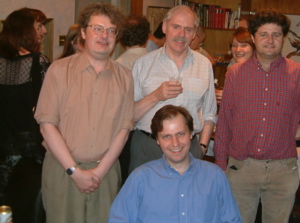
(Brian Micklethwait, David Farrer (back), Patrick Crozier (front), Michael Jennings)
Update: Yes Mum, that's right. I no longer have a left arm. I am sorry it had to be revealed to you this way.
You go to a party, and when you are leaving you cannot find your host because he is busy posting photographs of the party to the internet.
(Brian Micklethwait, David Farrer (back), Patrick Crozier (front), Michael Jennings)
Update: Yes Mum, that's right. I no longer have a left arm. I am sorry it had to be revealed to you this way.
Saturday, July 05, 2003
I really love the Onion
As well as being a dazzlingly spot on (and at times very close to the bone) parody of a regional newspaper, the Onion contains some of the smartest reviews of popular culture around. The people who write for it have to have a spectacularly good feel for popular culture to get the parodies right, and they use this without the parody in the review section. This couple of lines from their review of Terminator 3 has to be my favourite quote from a review in a while
As well as being a dazzlingly spot on (and at times very close to the bone) parody of a regional newspaper, the Onion contains some of the smartest reviews of popular culture around. The people who write for it have to have a spectacularly good feel for popular culture to get the parodies right, and they use this without the parody in the review section. This couple of lines from their review of Terminator 3 has to be my favourite quote from a review in a while
Terminator 3 finds his good cyborg once again squaring off against a more technologically advanced evil cyborg from the future, this time a foxy lady Terminator (newcomer Kristanna Loken) who's sort of like T2's shape-shifting Terminator as redesigned by the editors of Maxim. With her big eyes, stiff gait, and robotic voice, Loken suggests a cross between the ultimate sex doll and the little-girl robot from Small Wonder, only all grown up and ready to kill.
Thursday, July 03, 2003
Around the blogs
I have a brief piece on Wimbledon and cricket at Ubersportingpundit, and a piece on national anthems and July 4 at Samizdata.
I have a brief piece on Wimbledon and cricket at Ubersportingpundit, and a piece on national anthems and July 4 at Samizdata.
Hutchison Telecom Update
The half finished post on Hutchison Telecom's bizarre Australian "business" that accidentally got posted yesterday has been finished. It is down the page here.
The half finished post on Hutchison Telecom's bizarre Australian "business" that accidentally got posted yesterday has been finished. It is down the page here.
Wednesday, July 02, 2003
Tiny Cricket thingy
Yesterday, England tried to play Zimbabwe at Headingley. Sadly, though, there was lots of rain. After lots of delays, England batted first in what had been reduced to a 25 over game. Zimbabwe bowled pretty well, and good bowling from Streak and Blignaut reduced England to 4/81 off 16.3 overs: not very good for what was supposed to be a 25 over game.
Sadly though, it then rained again and the match was abandoned. Zimbabwe and England too three points each.
Not much to say. Zimbabwe are clearly a better one day side than test side. Zimbabwe have three more games in the tournament: one against England and two against South Africa. If they can win one more game (and they might, as they are playing okay) they have some change of making the final, depending on other results. If they can win two (a tall order) they will definitely make the final. A South Africa v England final looks to be overwhelmingly the most likely possibility, but Zimbabwe's participation is not impossible.
Update: Of course, when the rain did come down, England captain Michael Vaughan (thankfully back from injury) was batting quite well, with 35 off 45 balls. Under the rules, the finish of the game was allowed to be delayed one hour from the scheduled time, but this time had been used up already due to the late start. Vaughan said that since it stays light until at least 9pm at this time of year, then the powers that be should consider changing the rule to allow a further extension of play in order to get a result. This cricinfo article suggests that it is in fact ICC rules that restrict the extra time to one hour.
Of course, the situation is actually more complicated than this. There are also cases where day games are played on ground with floodlights and it would be possible to extend play into the evening if the lights were turned on. So, it would make sense for different rules to apply in different times and places. Interestingly enough, when I check the ICC playing conditions that apply for one day internationals, they seem to be very flexible. Condition 12.6 simply says that "The participating countries may agree to provide for extra time where the start of play is delayed or play is suspended". It seems to actually be the current rules for games in England that restrict the extra time to one hour. So, it doesn't look like we can blame the ICC here.
This is a shame. If the rules were such that games start in the morning and that play can continue until 9pm if necessary, I think there would be very few times when you would not get a result. If the players want this (and by Vaughan's comment they seem to) then this should really be looked at.
The world's stupidest mobile phone business
Scott Wickstein has some follow up comments on my recent Samizdata piece on mobile phone technology. (There is now a lengthy further discussion in the comments section of that post, which some people may want to read, although it does get fairly geeky towards the end). In particular he points out the mess that Hutchison telecom appear to be making with their recently launched 3G network in Australia. I agree, but there are two separate issues here. One is the mess being made by Hutchison specifically, and the other is the problems with the 3G technology in general.
In order to understand all this, it is necessary to go back in time somewhat, and to look at the history of the Hutchison company. The telecoms business is all an offshoot of a the Hutchison Whampoa conglomorate belonging to Hong Kong tycool Li Ka-Shing. In the early 1990s, a lot of countries issued 2G mobile phone licences, and in most cases they issued more licences than there had been 1G (analogue licences). Hutchison bought new entrant licences in a lot of places, and built and operated networks under the name "Orange". In most instances (but not all) these networks became very successful and Hutchison sold many of them to other players at the height of the telco boom and made a huge amount of money.
When 3G licences were issued in the late 1990s, Hutchison attempted to do the same thing again. They bought 3G licences aimed at new entrants in a whole host of countries, and they are now attempting to build networks and market share as new entrants. However, it seems much harder this time, as the technology doesn't work yet, the incumbents have a lot more market power than was the case when 2G went into operation, and there are economies of scale that apply to 2G that do not apply to 3G yet. It is possible to provide new services using 3G such as video calls, but people don't appear to want this.
Now, however, we go to Hutchison in Australia. Here, the mismanagement is mind-boggling. To start out, there were only three 2G (GSM) licences issued in Australia in the early 1990s. These were awarded (on a tender basis rather than auction) to Telstra, Optus, and Vodafone. Hutchison did not get one. The next round of spectrum auctions in Australia were in 1998, when two licences were issued for spectrum in the 800MHz band formerly used by analogue services. Telstra and Hutchison bought these, and both built networks using the American technology known as CDMA. In many ways this is a superior technology (particularly in rural areas) but far fewer CDMA networks have be built in the world than GSM, and Nokia in particular is in the GSM camp. While Nokia makes CDMA handsets for the US market, it for a long time refused to supply them in Asian markets. This restricted Hutchison's product (again sold as "Orange") because the phones they had were mostly Korean and didn't appeal to the fashion conscious. Despite a lot of advertising, this, mixed in with the late launch compared to other operators led to Orange picking up very few customers in Australia. (They have an astonishingl lousy market share of about 2.8%. The market share otherwise is something like Telstra 45%, Optus 35%, Vodafone 17%).
For some reason, when more GSM licences went on sale in Australia in 2000, Hutchison spent something like $800 million Australian to buy one of these. Nobody knows why, as they have since done nothing with it. It just seems they pointlessly poured $800 million down the drain. (OneTel also bought a GSM licence at this point, and with the help of Lucent built a network, but this was switched off when OneTel later went bankrupt).
Thuse there are actually five 2G mobile phone networks in Australia. Telstra owns two (one CDMA and one GSM), Optus owns one (GSM), Vodafone one (GSM), and Hutchison one (one CDMA). (There was also one more (GSM) network that belonged to OneTel, but this was switched off when OneTel went bust).
Now we get to 3G. There are actually two separate technologies for 3G phones, UMTS (W-CDMA), which is European, and CDMA2000, which was invented by Qualcomm of the US. Existing CDMA networks can be upgraded to CDMA2000 without buying new spectrum, but UMTS requires new spectrum. (It is possible to build a CDMA2000 network in new spectrum, but not mandatory). If you have an existing CDMA network, then it seems to make sense to upgrade to CDMA2000, because the cost is a lot less. Also, there is the small fact that CDMA2000 actually works, whereas UMTS doesn't really yet.
In 2000, 3G licences went on sale in Australia, and as the number of people who wanted licences and the number of licences available were approximately the same, they didn't cost much. All the incumbents bought licences. At present, Hutchison are the only company to have built a network. However, they have built it using the UMTS technology that is incompatible with their existing network, and which doesn't work. (They have done this because Hutchison have globally decided to use the UMTS technology everywhere, and they are just obeying instructions from head office). Telstra on the other hand are upgrading their existing 2G CDMA network to CDMA2000 and at the same time have a licence to build a UMTS network if they discover later that this is the technology that is becoming dominant worldwide.
Thus we have a situation where Hutchison in Australia have built two incompatible mobile networks, have spent 800 million dollars on a licence for another incompatible network that they haven't built, and with all this they have managed to obtain less than 3% market share. This boggles the mind.
(And as for video calling being an application that nobody wants, I couldn't agree more. Picture messaging is clearly an application that people do want. (I am in Venice. Here is a photograph of the canal. You are stuck at work. Nah nah nah nah). People however generally do not want the other person to see them when they talk. There are two many issues of clothes, make-up, bad hair days, and the like. The stupid thing is that this was discovered by AT&T in the 1970s. AT&T actually wasted an enormous amount of money discovering it. Now, however, we simply have companies with no memory learning the lessons of the past all over again. The reason Hutchison have promoted video messaging as their killer application is that it is the only way they can really differentiate themselves from the competition. It is the only feature that they presently have that their competitors don't have. They are desperately clinging to it, because without it their whole business case collapses.
Oops: A half-written draft of this article escaped into the wild here. I shall finish it later. Since Scott Wickstein already left a comment, I will leave it up for now, but I will replace it with a finished version later.
Further Oops: It got partially updated, but then my computer crashed and I lost some further changes. This post is doomed.
Update: It's finished. Yay.
A small milestone
The blog has just had its thousandth comment posted. (I think around 350 of the comments posted have been me responding to other comments, but I don't have an exact number). I find the comments section here to be rather cozy, almost like friends having a chat around a fire on a cold winter night with a good bottle of port. So thanks, everyone.
The blog has just had its thousandth comment posted. (I think around 350 of the comments posted have been me responding to other comments, but I don't have an exact number). I find the comments section here to be rather cozy, almost like friends having a chat around a fire on a cold winter night with a good bottle of port. So thanks, everyone.
Tuesday, July 01, 2003
A great Aussie invention
In Australia, beer bottles generally come in two sizes. The larger of these is known as a "long neck" and holds 750ml of beer. Typically, beer from such a bottle is poured into glasses, and may be shared by more than one person. Smaller bottles are known as "stubbies", and these used to be normally hold 250ml of beer, although 375ml is now more common. Typically, the top is removed from a stubby, and the beer is consumed directly from a bottle. (To achieve the full Australian male experience, this should be done while standing around a barbecue and occasionally prodding sausages with an oversized fork). Around 20 years ago, when I was a child, a change came over the design of the stubby. This was the invention of the "twist top". Rather than having a single round glass rim, the glass in the neck ot the bottle forms the shape of a thread. A standard metal top is fitted over the thread. This means that the bottle can be opened either using an opener, or by tightly wrapping your hand around the bottle top and twisting until the top comes off.
In Australia, this was an important innovation. It allowed men standing around barbecues to open their beer without needing to find an opener. And they could show their manliness by not flinching at the small amount of pain felt when opening a bottle this way. They could pretend that they in fact had hands toughened by manual labor in the somewhat mythical Australian outback. That kind of thing.
Before moving overseas, I just kind of assumed that this important innovation had affected beer bottle design elsewhere as well as in Australia. However, apparently not. I have not seen the twist top anywhere else. Beer bottles elsewhere seem to need openers. Foreigners have no need for the standing round the barbecue and opening beer bottles with their hands ritual. Curious.
BT Sucks
My usual e-mail address, mjj12@btopenworld.com, is not working very well at the moment. I am receiving e-mail, but at unpredictable times after long delays. If you really want to contact me, please send e-mail to mjj122@yahoo.com, which I shall check regularly today. Alternately, if you have received mail from me in the past, and you hit reply, you will find that the e-mail will go to a third address at a different ISP. This address is still largely spam-free, so I am not posting it on the web in any form.
My usual e-mail address, mjj12@btopenworld.com, is not working very well at the moment. I am receiving e-mail, but at unpredictable times after long delays. If you really want to contact me, please send e-mail to mjj122@yahoo.com, which I shall check regularly today. Alternately, if you have received mail from me in the past, and you hit reply, you will find that the e-mail will go to a third address at a different ISP. This address is still largely spam-free, so I am not posting it on the web in any form.
Monday, June 30, 2003
It's picture time
When in Bilbao recently, it was good to see that figures from authentic Basque culture are being used to instruct the people in how to correctly use a rubbish bin

So how do you say "Have a cow, man" or "Eat my shorts" in Euskera, anyway? I particularly like the picture of Barney on the beer can, which careful readers will observe was actually photographed on a different bin

When in Bilbao recently, it was good to see that figures from authentic Basque culture are being used to instruct the people in how to correctly use a rubbish bin
So how do you say "Have a cow, man" or "Eat my shorts" in Euskera, anyway? I particularly like the picture of Barney on the beer can, which careful readers will observe was actually photographed on a different bin
Something that annoys me
I have a piece on bag searches in Australian shops and the related civil liberties issues over at the White Rose
I have a piece on bag searches in Australian shops and the related civil liberties issues over at the White Rose
A good effort
A few weeks ago, I commented that in its home matches this season the West Indian cricket team had lost every match they played when the series in question was still undecided, and won every "dead" match after the series was decided. At the time there was one series to go: the two match test series against Sri Lanka. As I have written on this blog, the first match was drawn due to rain, so this in a sense broke the West Indian jinx. However, when it came to the crunch in the second test this weekend, it is nice to see that the West Indians came good. At the end of the second day's play, Sri Lanka were 5/129 in their second innings, a lead of 146 runs. The West Indies needed to bowl Sri Lanka out as quickly as possible and hope that their fine batting lineup could get the runs in a peculiarly low scoring match. In particular, it was time for Lara to play what is known in cricket as a "captain's knock", an innings in which the captain demonstrates to his teammates how it is done.
Before that, though, there were wickets to be taken. As it happened, Corey Collymore continued the job he started on Saturday evening, taking a total of 7 wickets for 57 runs. Despite a little resistance from Dharmasena and Vaas, Sri Lanka were bowled out for 194, setting the West Indies a very gettable target of 212, by most standards not very much, but (if achieved) the highest innings score of the match. The West Indies lost Gayle very quickly and Hinds with the score on 50, but after that Sarwan and Lara did the worlk with little difficulty. Sarwan was out for 82 with the scores level and one run required to win, and Lara did what was asked of him, being 80 not out at the end. In a way it was a shame that the target wasn't a few more, as that way Lara could have completed his sixth century in his last six matches against Sri Lanka. Anyway, the West Indies won the match by seven wickets and the series 1-0, with Collymore being declared man of the match and of the series. (That second award seems a little hard on Lara to me).
And so ends the West Indian home season. The West Indies dominated cricket from about 1980 to 1993, before falling into dreadful decline, and losing to just about everyone. This season they have shown signs that they are on the way back. They played well at times in the World Cup, thanks at least partly due to some great batting from Sarwan. Sadly, the combination of defaults, rain, and an upset in a game not involving them cost them a place in the second round of that tournament. They then went on to lose to Australia at home, but that happens to everyone. Thankfully, they showed some good moments in that series, and Lara batted superbly. Finally, they ended the season on a high note with this win over Sri Lanka. The West Indies play South Africa in South Africa at the end of the year. That should be good. I love watching West Indian cricket, particularly Brian Lara when he is in the sort of form he has been in recently. I must try to go there in four years: perhaps for the World Cup, perhaps for the Australian tour that follows it.
Briefly, South Africa played Zimbabwe in Canterbury yesterday. South Africa batted first and scored 5/272 off 50 overs thanks to 125 not out from Jacques Kallis, his second successive century in this series. This was always likely to be too much for the Zimbabweans, whose batting lacks the depth needed to chase that sort of score. The Zimbabweans made a reasonable fist of it, at one point being 2/146 off 33 overs, but after Friend and Flower were out the wickets tumbled, the Zimbabweans scrambling to 9/226 off the 50 overs and losing by 46 runs. Zimbabwe will likely have to win two of their last four matches to make the final, which is a tall order for them.
Yum
Apparently we are going to have Krispy Kreme in Sydney very soon. Perhaps I should return.
Update: Further research informs me that the store is open, and in fact that the only Krispy Kreme store outside North America is in Penrith. This is not where I would have picked it to be. Not that there is anything wrong with Penrith, particularly. It's just that the place is suburban and somewhat nondescript, although it does have a nice river running through it. That said, I can just imagine the store amongst all the other franchise operations outside Panthers World of Entertainment, next to the far less classy Spur Steak Ranch (one of the few Spur Steak Ranches outside Africa, but still not especially classy).
That said, it is probably somewhere else in Penrith entirely.
Sadly, they don't make film stars like this any more
Firstly Gregory Peck, and now Katharine Hepburn has died. She was 96. As we say in cricket playing countries, she had a good innings.
Firstly Gregory Peck, and now Katharine Hepburn has died. She was 96. As we say in cricket playing countries, she had a good innings.
Sunday, June 29, 2003
A man and his mobile phone
I have a lengthy piece over at Samizdata on trends in mobile phone technology.
I have a lengthy piece over at Samizdata on trends in mobile phone technology.
Saturday, June 28, 2003
This is one confusing cricket team
After playing very well to win a series against Pakistan last week, and playing pitifully to lose to Zimbabwe on Thursday, England today took on South Africa at the Oval in south London in the second game of the triangular one day series. South Africa played badly in the World Cup, and we are still trying to figure out how good their side is under new captain Graeme Smith. Smith won the toss and elected to bat, and the England side couldn't really contain the South African batsmen. Jacques Kallis in particular had a good day, scoring a fine 107. Boucher provided good support, scoring 55, and Pollock and Hall scored some quick runs at the end to give South Africa a very good 6/264 off their 50 overs.
This should have been hard for England to chase, but it wasn't. Trescothick (deputising as captain as Vaughan was out injured today) and Vikram Solanski scored exactly 200 for the first wicket (off only 31.6 overs) before Solanski was out for 106, his first century for England. England then lost a couple of quick wickets, but there was never any real danger. Trescothick was then sensibly cautious, and also scored a century, being 114 not out when England scored the winning runs for the loss of four wickets with one ball short of five overs to spare.
What can be said? Obviously it was a good win for England. At this point I have no idea how good England are. Actually, I think they are quite good, but they clearly don't have the mental strength of Australia. They can play well, but can lose focus as they did on Thursday and in the field today, although their batsmen saved them today. They don't have the ability to consciously turn the focus on when it is really needed. Australia can do this, and this is what makes Australia so impressive.
Of course, the other way of looking at it is that England have played five one day games so far this season, and when Trescothick has batted well they have won and when he hasn't they have lost. A cynic might say that in the one day game, they are simply way too dependent on one player.
I don't think this is true, but England need someone else to chip in, particulary on occasions when Trescothick has failed. Solanski was terrific today, but Trescothick was also, and that must have helped. (Still, it is very encouraging to see more players of Indian background coming into the England side. If England are to put good sides on the field in the future, that is where many of the players are going to have to come from). Dare I say it, the full time England one day captain needs to lead by example. When he is back, Vaughan needs runs. In one day cricket, he has not yet done so.
In other cricket, the second test between the West Indies and Sri Lanka continues. (I commented on day one elsewhere. The gist of it was that Fidel Edwards, playing in his first test and only his second first class game, took five wickets and Sri Lanka were bowled out for 208). This morning it looked like the West Indies would make a big score and take control, particularly when they were 0/38. However another inexperienced fast bowler, Ratnayake Nissanka, playing in only his fourth test, took five wickets for Sri Lanka. Aided ably by Muttiah Muralitharan (who took the vital wicket of Lara), the West Indies were bowled out for 191, and the match was back in the balance.
Sri Lanka then needed to bat well in order to set the West Indies a big target. Despite the fall of wicekts, the pitch looked okay to me. Given Lara, Sarwan etc are in the West Indian side, and given that Lara has scored five centuries in his last five matches against Sri Lanka, the larger the total the better.
As it happened though, the wickets continued to fall, this time shared between Collywood, Taylor, and Edwards. At stumps, Sri Lanka were 5/129. Given that Tillakaratne is still there Sri Lanka could make a decent score, but the chances are they won't. My money is on a target of around 200 being set, and the West Indies making it easily, mainly because I don't think Lara is going to fail for the second time in the match. Although, given how wickets have been falling, who really knows? It's a good tight match between two quality sides, and these are good to see.
Friday, June 27, 2003
Thoughts on privacy
In commemoration of Orwell's 100th birthday, Neuromancer author William Gibson had an op-ed piece in Wednesday's New York Times, in which he discussed Orwell's vision, and how it was influenced by its time. In particular, Gibson believes that Orwell's vision was influenced by the broadcast nature of the media at the time: radio and the nascent invention of television were highly centralised. The surveillance scheme (and the totalitarian states) envisioned in 1984 were centralised in the same way, from some giant central security apparatus. Gibson believes that today's world, and the world of the future, is different. Greater surveillance will be mixed with much greater freedom of information. People with access to all this new information will consist of many non-state as well as state actors. We will live in a world with much less privacy, but not necessarily much less freedom. Surveillance states without this fancy new technology were pretty effective, and still are pretty effective in places (from North Korea to Burma to Cuba) where old technological paradigms still apply. Would these states have been more oppressive if the people runing them had PCs? It's hard to say. Would the presence of PCs in the security apparatus in East Germany rather than mountains of paper records have prevented the end of European communism? It's doubtful. Changing surveillance technology is taking us somewhere new, it may be that the vision of Orwell provides a good guide as to what it is.
After quickly observing that Gibson sounds rather like Brian Micklethwait, I will observe that Gibson is at least partly right. The greater freedom of information that results from many to many communications networks changes things dramatically. We saw glimpses of this in the 1980s with the invention of the fax machine, which more or less removed the mass media's ability to bury a story that the people were not supposed to know about. (The key story was something tawdry: a transcipt allegedly of the Prince of Wales talking to his mistress). This reached every office in London seemingly in minutes. The media and hence the courts could no longer supress things like that. With the invention of e-mail and SMS text messaging, such communications became more ubiquitous, and no longer tied to the home or office.
We are suddenly in a world where a great deal of information is being collected on us and transmitted to other places, and yet at the same time, we are collecting a lot of information on ourselves, and transmitting it voluntarily, and to some extent this controls the flow. Much of this information is and will continue to be cultural rather than political in content. Like Brian, I am fascinated by this phenomenon, which can also be for the good. Due largely to the use of SMS messaging, the Chinese government this year completely failed to keep information secret about the spread of the SARS virus in China. People throughout the country knew far more about what was going on than the government wanted them to know. The Chinese government now seems to know that it cannot keep things secret like this any more, and as today's Economist discusses, the consequences could be profound.
I agree with Gibson that things are less Orwellian, but that doesn't necessarily mean things are good. More information is being collected. I agree that this can't be avoided. The questions are how is it going to be collected, who is going to be collecting it, how may it be used. Virtually everywhere government continues to grow in size, and in many places government surveillance systems and databases of information become larger, and governments continue to use the threat of terrorism and the simple fact of the existence of the new technology to expand their powers and the scope of such systems. While I think the simultaneous new openness of information increases the potential for these systems to be embarrassed by other parties, the potential for misuse of such information remains enormous. The ability of incorrect information to ruin people's lives and for bureacrats to annoy and harrass the lives of ordinary people is also multiplied dramatically by the new technology.
So what do we do? I think we have to acknowledge that while technology has changed, human nature fundamentally hasn't. Over the last 1000 years, an entire legal system and system of rights has evolved to protect people from intrusive government and other intrusive parties. This is why we have accountability to courts and elected officials. This is why we have presumption of innocence. This is why nobody can search my home without a warrant. It isn't good enough to say that technology has changed, and therefore these rights are no longer relevant and must be removed, because those things about human nature that made these protections necessary in the first place have not changed, and this is something we still need to be protected from. In fact we need to see how they can be extended into the digital world. The alternative is to find out in a few years that great miscarriages of justice have occurred due to the lack of them, and we then have to either resign ourselves to living in a world where great miscarriages of justice occur, or establish a new set of protections from scratch.
And the fact is a great many politicians, policemen and bureacrats want to take these protections away. The danger is in some ways not so much the new technology itself, as the fact that it puts everything in flux. Those people who have always wanted ID cards, the ability to search houses without warrants, the ability to listen to private conversations and such have an excuse to start talking about these issues again and to argue that the issues are not settled. And the new technology provides a tremendous amount of jargon with which these same old proposals can be worded to make them sound like they are not the same after all. Which is why it is important for us to make it clear when they are.
Crossposted to The White Rose
More on The Passion
Long term readers will remember that a few months ago I wrote about Mel Gibson's upcoming film The Passion, which tells the story of Christ and is entirely in Latin and Aramaic. In particular, I wondered to what extent the content of the film would be influenced by the somewhat extreme Catholic sect to which Gibson belongs, and, given the extremely unpleasant views (holocaust denial, etc) of certain members of Gibson's family, whether the film would be anti-Semitic.
Aint it Cool News has pointed me to the first review of the film from someone who has actually seen it. (Follow up posting from the same person here). It's a good review, saying that the film is not anti-Semitic, that it is a fairly faithful telling of the Gospel of St John. Previous reports that the film would not have subtitles turn out to not be true. We are still not quite sure when we are going to see it, as distributors had previously shied away from it due to the controversy and perceived eccentricity of the project.
The film now sonds less eccentric, which in a way is a shame. I am now quite interested in seeing it.
Thursday, June 26, 2003
A fine innings from Grant Flower
Okay, England have just played a test series against Zimbabwe, in which Zimbabwe were absolutely thrashed. Then, England played a one day series against Pakistan, a much better rated side, and played well to win the series. Today, England played Zimbabwe in the first match of a triangular one day series that also includes South Africa. It should be a doddle for England, right.
Well, no. Before we start, it is worth looking at the Zimbabwe's history of playing one day internationals.
Zimbabwe played their first one day international in the World Cup in 1983, when they played Australia in the opening match. Amazingly, they won the match, a result that cost Australia a place in the semi-finals of that tournament. (Australia found this deeply embarassing, and have not taken Zimbabwe lightly again. As a consequence, Australia have won all of the 19 games they have played against Zimbabwe since). After that game, Zimbabwe lost their next 18 one day internationals. They did not play England until the 1992 World Cup, and their first game against England was their next win. This victory was a major factor in Zimbabwe being granted test status later that year.
Rather than spurring England on to a lot of victories, as had happened with Australia's 1983 loss to Zimbabwe, this loss appeared to have really spooked England, and they managed to lose five of their next seven matches against Zimbabwe. After that, England got their act together, and going into today's game, England's overall record against Zimbabwe was 15 wins and 7 losses. However, there has always been a feeling that England have a certain dodginess against Zimbabwe.
And so it turned out today. Zimbabwe sent England in. England got off to a reasonable start, but some good bowling by Heath Streak in particular reduced England to 6/144. Clarke and Read managed to score a few more runs, but England were bowled out for 191. Flintoff's 53 was the top score. Not a very good effort.
Zimbabwe only needed to bat decently to win, but on this tour so far they have not managed to bat decently. And at the start they didn't appear to be batting decently, slumping to a dreadful 4/15. But the very experienced Grant Flower was then batting. While not the world class player his brother is, Flower is a quality international class player, and he played very sensibly today, scoring at the right run rate without attempting to do anything silly. Stuart Matsikenyeri did a good job of staying with him, before being out for 44 to a rash shot with the score on 111. Heath Streak was out shortly afterwards, and England again looked like winning. However, Sean Ervine did a very good job of sticking with Streak, and the two players got Zimbabwe home, with four wickets and two overs to spare. Grant Flower ended up with 96 not out.
I have very mixed feelings about the Zimbabwe cricket team being in England. I think the tour should have been cancelled due to the clear political interference in the selection of the team. However, the tour so far must have been pretty demoralising for the Zimbabwean cricketers. Today was a good win, and I am sure it makes them feel a little better.
Subscribe to:
Posts (Atom)