I left a comment over that The Register that got a little out of control. If anyone wants to hire a telco analyst, I am available.
In the mid 1990s, there were two 2G GSM mobile networks set up in China, one by the incumbent operator China Telecom, and one by a new company China Unicom. (We say "new company", but all these things were and generally still are state owned).
In 1999, the mobile assets of China Telecom were split off to found China Mobile. The advantages of being part of the incumbent fixed line operator up to that point were such that China Mobile was by far the market leader by then, a position it retains to this day. (China Mobile is by far the biggest mobile operator in the world). At the same time, more assets of China Telecom were spun off as China Netcom to build high speed internet infrastructure in China - i.e. to be a large ISP.
On order to supposedly compete with fixed line services, China Unicom was also given a Wireless Local Loop (WLL) licence. For this, it used the IS-95 CDMA technology developed by Qualcomm in the US, which was being sold as a WLL solution at that time as well as being a fully featured cellular system (as used by Verizon and Sprint in the US). China Unicom were highly aware of this, and thus used the WLL licence to build a second mobile network.
Meanwhile, the Chinese had decided that they did not want to pay huge levels of royalties to western companies to operate 3G mobile phone services, and decided that they would develop an "indigenous" 3G standard called TS-SCDMA to be used in China. (In actual fact, this was originally developed by Siemens to be possibly used as the European 3G standard, but this lost out to W-CDMA). While this was being further developed and made ready for use in China, no 3G licences were issued for use in China.
Thus, approaching the 2008 Olympics, there were no 3G services in China, and the Chinese were concerned that China Mobile was too dominant, and they were concerned that their "indigenous" 3G solution had not been launched yet, and they were embarrassed by the prospect of foreigners coming to the games and discovering that there was no 3G service, and they retrospectively decided that what was better was to have a number of telcos competing on both wireless and fixed line services rather than separating by function.
Thus the industry was reorganised:
China Mobile was awarded a TD-SCDMA licence, and ordered to roll it out at once.
China Unicom was given a W-CDMA licence compatible with the rest of the world, and was forced to buy China Netcom so as to offer fixed line and wired ISP services. China Unicom was forced to sell its IS-95/CDMA network to China Telecom.
China Telecom was instructed to buy China Unicom's said IS-95/CDMA network, and upgrade it to 3G speeds. (China Unicom had already done this to some extent).
Thus we have three mobile networks, the biggest of which has 2G GSM and a strange, 3G network using a standard used nowhere else that few people use and which doesn't work very well, but which has most of the customers. (There is no number portability in China, so customers don't often switch network). The second largest, China Unicom, has the combination of GSM and UMTS/W-CDMA that most iPhones are designed for, and that is why they have been the only network offering the iPhone until now. (Apparently several million people use unlocked iPhones on China Mobile's 2G GSM network in EDGE mode only).
And you have a third mobile network, which uses CDMA/IS-95 as used by Verizon in the US. Apple's introduction of a phone for Verizon earlier this year didn't quite solve the problem, though, as the use of a SIM is optional on CDMA, and China Mobile uses a SIM and Verizon doesn't, and the CDMA iPhone 4 does not accept one. Hence we have had to wait a little while for that problem to be ironed out. My assumption is that the new iPhone(s) that we will see later this year will solve that problem.
China Mobile is going to use 3GPP LTE for 4G phones, as apparently are everyone else in China. At that point all three carriers in China will probably carry the iPhone, but we won't see that until late next year at the earliest.
Wednesday, July 13, 2011


Monday, July 11, 2011
Etymological puzzles.
When staying in hotels in Asia, it is quite common to find that the hotel will offer a "baby sister service". This is exactly the same as a baby sitter, of course, and the expression makes sense because in places where people have large extended families, it is a task that is often by performed by a sister. "Baby sitter" doesn't appear to make much sense if you are a non-native English speaker, so the phrase has been transformed into another similar sounding phrase that we would see as incorrect, but which makes more sense in the context.
Similarly, perhaps, in Malaysia and Indonesia one will often stay in an institution called a "rest house". This is a place of accommodation that lacks the full facilities of a hotel, basically. The name makes perfect logical sense - this is after all a house in which you rest. I do wonder, though, whether the word actually comes from people with limited English mishearing the word "guesthouse", and thus converting it into something slightly different.
Similarly, perhaps, in Malaysia and Indonesia one will often stay in an institution called a "rest house". This is a place of accommodation that lacks the full facilities of a hotel, basically. The name makes perfect logical sense - this is after all a house in which you rest. I do wonder, though, whether the word actually comes from people with limited English mishearing the word "guesthouse", and thus converting it into something slightly different.
Monday, May 09, 2011
Photo composition moments

I was looking for a nice contrast of things, and I thought that the bullring in the foreground, an in some ways fairly typical spanish city in the middle, and a long line of cranes indicating that this is indeed one of Europe's most important ports in the background was nice.
Algeciras, like Felixstowe, is one of those ports that is not historically very important but is a very major point now due to its strategic location. The really large ships on the route through the Mediterranean and Suez Canal to Asia are not going to divert to Valencia or Barcelona, so they stop at the very bottom of Spain. Containers can then be transferred to smaller ships to head north or elsewhere, or onto trucks or trains to be taken to other points in Spain. (When container shipping arrived in UK, another reason why much of the shipping moved from London to Felixstowe was that the Port of London was very heavily unionised and Felixtowe wasn't. I am not sure if a similar factor came into play in Spain, given that the alternative of Cadiz is also famous for its labour disputes and militant union men. in any event, Algeciras is now the key port.
With respect to the photo, having taken it I then realised that I also had the Rock of Gibraltar behind the port, and it is always delightful to get more in the photo that you intended.
Of course, "hub" seaports (in which containers are unloaded from one ship to another, or possibly other modes of transport) are like hub airports. Location is important in the sense that they need to be very conveniently on the route from A to B, but local markets are possibly less important than the strategic location and efficiency of a port. The busiest container port in the world is in Singapore, which is a significant but not very large market in a perfect location at the end of the Straits of Malacca. (The two Chinese ports of Hong Kong and Shenzhen - essentially two parts of the same urban area with a border down the middle - are each individually close to Singapore in terms of size, however. Combined they are massively busier).
Algeciras on the Straits of Gibraltar is a perfect place for such a port, but so is Tangier in Morocco. (The Indonesian island of Batam is as good a place as Singapore, too, but building a major port in Indonesia is just too hard). And as it happens, there is an enormous project to build a gigantic port in Africa, directly opposite Algeciras, the so called Tanger-Med, port, actually about 40km east of Tangier. I visited it the day before I visited Algeciras.
Well, when I say visited, I mean "went past it in a bus", actually, so my photographs are perhaps a little lacking because of this. However:

It's actually a lot bigger than that - I was only able to get a certain amount into the photo. In fact, when complete, it will be much bigger than the port at Alegiras on the Spanish side.

There is a lot more under construction, too. Plus there is an extensive motorway system heading south. When the port is complete, it will be the largest and hopefully busiest in Africa. To some extent it is to compete with Algeciras - in terms of transferring containers from one ship to another, Tanger-Med will be more modern and will have lower cost and (hopefully) more flexible labour. As well as that, the port is about trade between Africa and Spain, Europe, and further afield, and this is all good too.

Spanish registered truck, there.
One hopes that this is actually a sensible project, and that it will aid African development and international trade in a significant way. This of course requires efficient management, relatively free markets, the rule or law, and reasonably low levels of corruption. The port is apparently being built with government money, and run by "a private company with public sector privileges". That sounds like an invitation for trouble, but is probably no worse than the arrangements by which many ports are run. One does also wonder from who the Moroccan government has borrowed the money. There is a reservoir of cheap capital that is used to fund Arab infrastructure (and other) projects that is ultimately based on the huge oil wealth of the Emirate of Abu Dhabi. Like all mispriced capital, such money can be useful if you are trying to borrow money to finance and build a sensible business, but the mispricing also tends to encourage bubbles, rentseeking, excess, and an ultimate collapse under a mountain of debt. Given the strategic location of Tanger-Med, a sizeable port is sensible, but one hopes that massive overbuilding has not occurred. The story of EU aid for infrastructure projects in Spain and Portugal was starting off with sensible projects, and ending up with absurdity, and one hopes that this is not similar.
Thursday, April 28, 2011
Impressing the Swiss
Last week, I spent some time waiting for a bus at this road intersection in Croatia. The direct bus from Bihać in Bosnia goes to Zagreb, but as I was going to Zadar, I had to get off at the intersection and wait for the bus to Zadar.
As I was waiting, I found a mobile phone in the gravel beside the road. It was switched on. The menus were in German, and the phone (and SIM) were branded with the Orange network. I threw it in my bag, and thought little more of it for the moment.
However, when I got back to London, I realised that I still had it. I couldn't switch it on again, because the SIM in the card was PIN protected. However, when I put my own SIM in the phone, it worked fine. The phone was not network locked. After a little navigation through the menus, I managed to switch the phone to English language mode. There were a few SMS messages stored in the phone (in German, and apparently describing a trip to Bosnia) and of course there were phone numbers stored in the address book. However, these were all in national format, without a country code. Numbers that were clearly people's mobiles were of the form 07xxxxxxxx. A number entitled "pizza" was of the form 08xxxxxxxx. A business number, presumably.
Now, whose phone was it? Orange do not have a network in Croatia or Bosnia, and the phone was set to German. So the phone belonged to another foreign visitor. Orange do not have a network in Germany either, but they do have a network in Austria. Many, many Austrians visit Croatia - they used to rule it - so my first guess was that the phone belonged to an Austrian. However, a quick check of the Austrian telephone numbering system indicated that Austrian mobile numbers have the form 06xx, and 07xx and 08xx are all kinds of extraneous services rather than regular numbers. So, German speaking but not Austrian or German. Who then?
Further checks indicate that Orange does own a network in Switzerland, 07xx does denote mobile numbers in Switzerland, and 08xx is used for free and shared cost services often used by businesses. So, Swiss.
At this point I am on a roll, and national stereotypes come into it. I would expect a Swiss person to try to return my phone to me, so I am going to make an extra effort in return. (I might not do this for certain other nationalities. On the other hand, strangers have on occasion gone to some trouble to return lost phones to me, so in any event one wants to return the favour, as it were). There is also a sense that if I do get in contact with a Swiss person, that the contact will then be uncomplicated and hassle free, due to their being Swiss. I don't have the name or number of the owner of the phone, so I look through the names in the address book. One of them is listed as "Mama", which sounds promising. Mama's date of birth is listed in the phone as some time in 1970, so Mama presumably is okay with being sent text messages. (She also has children old enough to lose phones while travelling in the Balkans, despite being younger than me. Perhaps I need to get a move on with certain aspects of my life. But I digress).
I look up the country code for Switzerland, which is 41. I change the (national) number for Mama into an international number, and send two text messages (in English) to the number, stating that I found a phone belonging to one of her children in Croatia, and that if provided with an address, I will return the phone.
The next morning I receive a phone call from Switzerland. A young man speaking excellent but (slightly) accented English tells me that I have his girlfriend's phone, and is slightly amused when he discovers it is in London. ("Ah. 44 is England"). He gives me an address in the Swiss town of Chur, capital of the canton of Graubünden, near the Austrian border and just south of Liechtenstein. I haven't been to Chur, but I have been quite close nearby. Interestingly enough, Graubünden is the only canton of Switzerland where the Romansh language is spoken. I doubt Samsung make phones with Romansh menu options (although Linux probably has Romansh options). However, as the town's name was spelled "Khur" by the man on the phone, and that is the Swiss German spelling, I guess the phone did in fact belong to a German speaker.
I actually verified the address with Google Maps before sending the phone, and as Google gave the name of the town as "Chur" (the standard German spelling), that is what I used. I suspect it will get there.
Unfortunately, I missed something, of no relevance to the problem of returning the phone, but still irritating. The Swiss telephone numbering system mixes geographic and non-geographic numbers in an ugly way, and as it happens 08x, is used for freephones, shared cost numbers, and the town of Chur, for which the code is 081. As it happened, the pizza shop actually had a local number, so I should have been able to figure out that the phone came from Chur. However, I wasn't looking carefully enough, all I really wanted to know was the country, and I was not expecting the number system to be that inelegant.
Attentive readers will also probably suggest that it would have been simpler to simply read the SIM number off the SIM, obtain the mobile country code from the SIM number, and find out that it was Swiss that way. This is true, but the SIM number is in tiny writing, and my eyesight is not as good as it used to be.
As I was waiting, I found a mobile phone in the gravel beside the road. It was switched on. The menus were in German, and the phone (and SIM) were branded with the Orange network. I threw it in my bag, and thought little more of it for the moment.
However, when I got back to London, I realised that I still had it. I couldn't switch it on again, because the SIM in the card was PIN protected. However, when I put my own SIM in the phone, it worked fine. The phone was not network locked. After a little navigation through the menus, I managed to switch the phone to English language mode. There were a few SMS messages stored in the phone (in German, and apparently describing a trip to Bosnia) and of course there were phone numbers stored in the address book. However, these were all in national format, without a country code. Numbers that were clearly people's mobiles were of the form 07xxxxxxxx. A number entitled "pizza" was of the form 08xxxxxxxx. A business number, presumably.
Now, whose phone was it? Orange do not have a network in Croatia or Bosnia, and the phone was set to German. So the phone belonged to another foreign visitor. Orange do not have a network in Germany either, but they do have a network in Austria. Many, many Austrians visit Croatia - they used to rule it - so my first guess was that the phone belonged to an Austrian. However, a quick check of the Austrian telephone numbering system indicated that Austrian mobile numbers have the form 06xx, and 07xx and 08xx are all kinds of extraneous services rather than regular numbers. So, German speaking but not Austrian or German. Who then?
Further checks indicate that Orange does own a network in Switzerland, 07xx does denote mobile numbers in Switzerland, and 08xx is used for free and shared cost services often used by businesses. So, Swiss.
At this point I am on a roll, and national stereotypes come into it. I would expect a Swiss person to try to return my phone to me, so I am going to make an extra effort in return. (I might not do this for certain other nationalities. On the other hand, strangers have on occasion gone to some trouble to return lost phones to me, so in any event one wants to return the favour, as it were). There is also a sense that if I do get in contact with a Swiss person, that the contact will then be uncomplicated and hassle free, due to their being Swiss. I don't have the name or number of the owner of the phone, so I look through the names in the address book. One of them is listed as "Mama", which sounds promising. Mama's date of birth is listed in the phone as some time in 1970, so Mama presumably is okay with being sent text messages. (She also has children old enough to lose phones while travelling in the Balkans, despite being younger than me. Perhaps I need to get a move on with certain aspects of my life. But I digress).
I look up the country code for Switzerland, which is 41. I change the (national) number for Mama into an international number, and send two text messages (in English) to the number, stating that I found a phone belonging to one of her children in Croatia, and that if provided with an address, I will return the phone.
The next morning I receive a phone call from Switzerland. A young man speaking excellent but (slightly) accented English tells me that I have his girlfriend's phone, and is slightly amused when he discovers it is in London. ("Ah. 44 is England"). He gives me an address in the Swiss town of Chur, capital of the canton of Graubünden, near the Austrian border and just south of Liechtenstein. I haven't been to Chur, but I have been quite close nearby. Interestingly enough, Graubünden is the only canton of Switzerland where the Romansh language is spoken. I doubt Samsung make phones with Romansh menu options (although Linux probably has Romansh options). However, as the town's name was spelled "Khur" by the man on the phone, and that is the Swiss German spelling, I guess the phone did in fact belong to a German speaker.
I actually verified the address with Google Maps before sending the phone, and as Google gave the name of the town as "Chur" (the standard German spelling), that is what I used. I suspect it will get there.
Unfortunately, I missed something, of no relevance to the problem of returning the phone, but still irritating. The Swiss telephone numbering system mixes geographic and non-geographic numbers in an ugly way, and as it happens 08x, is used for freephones, shared cost numbers, and the town of Chur, for which the code is 081. As it happened, the pizza shop actually had a local number, so I should have been able to figure out that the phone came from Chur. However, I wasn't looking carefully enough, all I really wanted to know was the country, and I was not expecting the number system to be that inelegant.
Attentive readers will also probably suggest that it would have been simpler to simply read the SIM number off the SIM, obtain the mobile country code from the SIM number, and find out that it was Swiss that way. This is true, but the SIM number is in tiny writing, and my eyesight is not as good as it used to be.
Friday, April 08, 2011
A general frustration
When I posted this piece on Samizdata about getting held up in airport security and missing a flight yesterday, my thought was that I was perhaps being a little self-indulgent and I would be taken to task by someone in the comments for this.
Nothing like that though. Just sympathy, and many, many more insults for airport security policies.
Nothing like that though. Just sympathy, and many, many more insults for airport security policies.
Wednesday, March 16, 2011
Feel the me
Sadly, I am definitely one of these.
Me in Turkey last week: 15 inch laptop, iPad, Kindle, Android phone, dumb phone, digital SLR, two additional lenses, external card reader and spare memory cards, one headset.
Me in Turkey last week: 15 inch laptop, iPad, Kindle, Android phone, dumb phone, digital SLR, two additional lenses, external card reader and spare memory cards, one headset.
Monday, February 21, 2011
Thursday, December 23, 2010

Thursday, December 09, 2010
Cricket posting
English person: "Yeaaahhhhh. It's amazing. Our cricket team has thrashed yours. I bet you are really appalled and upset this morning. Your team is crapppp!!!!!
Australian person: Yes. I've known this for months if not years. While we would love to win the Ashes back, I am not dramatically more upset than I was yesterday. The decline of my cricket team is a more a long running, endless agony of the soul than anything sudden.
English person: Surely this must come as a surprise to you. It does to me.
Australian person: No. Also, Ricky Ponting is an idiot who should have been sacked in 2005. I've known this since 2005. Really astute people have known it longer. Now please go away.
Australian person: Yes. I've known this for months if not years. While we would love to win the Ashes back, I am not dramatically more upset than I was yesterday. The decline of my cricket team is a more a long running, endless agony of the soul than anything sudden.
English person: Surely this must come as a surprise to you. It does to me.
Australian person: No. Also, Ricky Ponting is an idiot who should have been sacked in 2005. I've known this since 2005. Really astute people have known it longer. Now please go away.
Saturday, November 06, 2010
The UEA is an even scarier place than I thought


Really, should American fast food chains even be allowed to operate in places like this?
Monday, November 01, 2010
KEEP PLANET GREEN
My inkjet printer had run out of ink. A seller on ebay offered me "compatible" cartridges for about half what Canon were charging, so I ordered a set. They took a couple of days to arrive, the seller gave me positive feedback on ebay before I received them, and my printer is working perfectly with the new ink cartridges. All good.
However, as well as the full cartridges, the seller sent me a return envelope with a prepaid postage label with an address in Coventry, and the words "KEEP PLANET GREEN. Recycle empty cartridges" on it. It was pretty obvious what was going on. The seller wanted me to send him my empty cartridges so that he could fill them with ink and then sell them to somebody else.
This is fine, of course. In fact, this is good. If someone is making a living doing this, well done and good luck to him. (The absence of an article between "KEEP" and "PLANET" makes me think he is Slavic, and probably Polish. Once again, good). Interesting, though, that he thinks that the best way to encourage his customers to send him their empty cartridges is through Green guilt-trippery. He might be right. Personally I would prefer he simply stated "Please give me your empty cartridges so that I can refill them and sell them to somebody else" or (best of all) "Please return your empty cartridges and I will give you £1 off your next order".
That said, I put my empty cartridges in the envelope and popped them in a postbox. He gave me good customer service and is most welcome to them.
However, as well as the full cartridges, the seller sent me a return envelope with a prepaid postage label with an address in Coventry, and the words "KEEP PLANET GREEN. Recycle empty cartridges" on it. It was pretty obvious what was going on. The seller wanted me to send him my empty cartridges so that he could fill them with ink and then sell them to somebody else.
This is fine, of course. In fact, this is good. If someone is making a living doing this, well done and good luck to him. (The absence of an article between "KEEP" and "PLANET" makes me think he is Slavic, and probably Polish. Once again, good). Interesting, though, that he thinks that the best way to encourage his customers to send him their empty cartridges is through Green guilt-trippery. He might be right. Personally I would prefer he simply stated "Please give me your empty cartridges so that I can refill them and sell them to somebody else" or (best of all) "Please return your empty cartridges and I will give you £1 off your next order".
That said, I put my empty cartridges in the envelope and popped them in a postbox. He gave me good customer service and is most welcome to them.
Tuesday, October 05, 2010
Thursday, September 16, 2010

Thursday, August 26, 2010
Ways of looking at things
I had a bad accident last year. I was wearing shoes with soles with poor traction. I slipped when going down some stairs. I put a hand out to stop the fall and did this. I had pretty much everything on that list except for re-fracture, compression neuropathy and tendon rupture. I was in a lot of pain for about nine months, but this is now mostly gone. I have regained the ability to do everything I normally do on a day to day basis (touch type, for instance), but I have some problems doing anything that involves strength in my left hand.
In any event, I was having lunch with a friend yesterday. I explained the above.
"Can't you get it fixed?"
"Not at the moment, no".
"What do you mean?"
"Not at the present level of technology".
He looked at me for a moment, and the I guess he acknowledged that this was reasonable. It is absolutely the right way of looking at things though. In things such as artificial body parts (an artificial joint and perhaps artificial tendons to go with it) and surgical techniques, the rate of advance is sufficiently fast that one must consider it with respect to your own health.
In any event, I was having lunch with a friend yesterday. I explained the above.
"Can't you get it fixed?"
"Not at the moment, no".
"What do you mean?"
"Not at the present level of technology".
He looked at me for a moment, and the I guess he acknowledged that this was reasonable. It is absolutely the right way of looking at things though. In things such as artificial body parts (an artificial joint and perhaps artificial tendons to go with it) and surgical techniques, the rate of advance is sufficiently fast that one must consider it with respect to your own health.
Wednesday, August 25, 2010
Some additions


Friday, July 30, 2010
God bless globalisation
I am an Australian who is regularly resident in London. I am sitting in an Irish pub in Bucharest, drinking Danish branded beer (probably brewed locally) and watching a rugby match between Tonga and Fiji on the television.
Seriously, we need to get Romania into the six (seven) nations as soon as possible.
Seriously, we need to get Romania into the six (seven) nations as soon as possible.
Sunday, July 04, 2010
A bit of a racket.
My electrical supplier is Scottish and Southern Energy. (This company came to be after a merger between Scottish Hydro Electric and Southern Electric. Operations appear to have been fully merged, but both brands are still used, presumably due to petty intra-Britain nationalism, so you get your bill from Scottish Hydro if you live in Scotland and Southern Electric if you are in England). I pay by direct debit. I had set up a direct debit to pay £40 a month when I moved into the flat, and up until now that seems to have covered my electrical usage.
Yesterday, however, I received my latest electricity bill. It stated that my account was £110 in debit, and that therefore my payments were to be increased from £40 to £58 a month in future to make up for this. I was puzzled by this, as my previous bill had shown the account at approximately zero and I had spent a significant time out of the UK during that period with all my electrical devices turned off. It was thus barely credible that I was using 70% more electricity than last year. Therefore, I examined the bill more carefully.
The bill was not based on a recent meter reading, but instead was based on an "estimate". I went and read the meter myself, and actual usage was a good deal less than the estimate. As far as I can tell, lacking an actual reading Scottish and Southern simply made something up on the assumption that I was using more electricity than I had done previously. Having done that, they used this entirely made up number to justify increasing my monthly payments.
I called the customer service number on my bill, and I was interrupted perhaps a quarter of the way into describing the situation, and the nice Scottish lady on the other end of the phone asked me to simply tell her the correct reading and she would fix it, which she did. My direct debit payments were switched back to £40 a month. I was slightly concerned, however, by the extent to which she seemed to understand the problem before I even explained it to her. It's almost as if it happens a lot.
I would be intrigued to know what would have happened had I not done this. When the meter was read, would my payments be reduced to move that (now massively in credit) account back towards zero, or would the credit balance be allowed to continue increasing as the debits continued to exceed the actual cost of usage? If so, this is a nice little way for the company to get its customers to fund its working capital requirement for it.
Yesterday, however, I received my latest electricity bill. It stated that my account was £110 in debit, and that therefore my payments were to be increased from £40 to £58 a month in future to make up for this. I was puzzled by this, as my previous bill had shown the account at approximately zero and I had spent a significant time out of the UK during that period with all my electrical devices turned off. It was thus barely credible that I was using 70% more electricity than last year. Therefore, I examined the bill more carefully.
The bill was not based on a recent meter reading, but instead was based on an "estimate". I went and read the meter myself, and actual usage was a good deal less than the estimate. As far as I can tell, lacking an actual reading Scottish and Southern simply made something up on the assumption that I was using more electricity than I had done previously. Having done that, they used this entirely made up number to justify increasing my monthly payments.
I called the customer service number on my bill, and I was interrupted perhaps a quarter of the way into describing the situation, and the nice Scottish lady on the other end of the phone asked me to simply tell her the correct reading and she would fix it, which she did. My direct debit payments were switched back to £40 a month. I was slightly concerned, however, by the extent to which she seemed to understand the problem before I even explained it to her. It's almost as if it happens a lot.
I would be intrigued to know what would have happened had I not done this. When the meter was read, would my payments be reduced to move that (now massively in credit) account back towards zero, or would the credit balance be allowed to continue increasing as the debits continued to exceed the actual cost of usage? If so, this is a nice little way for the company to get its customers to fund its working capital requirement for it.
Saturday, May 29, 2010
Unimportant observation of the day
Once upon a time, a young Scottish lady with who I was a little enamored (okay, a lot enamored - sad story) told me about how as a child she had doubted the existence of dolphins. These were apparently creatures from imaginary stories, like the tooth fairy. This was not a childhood belief I was able to share, because I lived near the Australian coast, and schools of dolphins swimming past were something I commonly saw. Once in a while I would see whales, too.
What makes me remember this now is that I was having a conversation with someone recently and the subject of penguins came up somewhere. (Perhaps we were talking about Linux). The person observed that penguins were exotic and strange creatures to him, and I observed that "Surely you must see them off (and on) the coast of Scotland sometimes". This observation was seen as somewhere between odd and hilarious.
Thanks to Wikipedia, I have since discovered that penguins for some reason only live in the southern hemisphere. For me, penguins are like dolphins. They were quite common where I grew up. In the evenings as I child I would see and hear them running along the beach in the distance. Once, we had one in our bathtub for a few days, as it had managed to get caught in a fishing net that had been washed up on the beach, and my father had rescued it in the hope that it would get better and he could let it go. (If I recall quickly, it was loud and vicious). Until now, I had made the assumption that penguins were pretty common on a much larger portion of the coastlines of the world than is in fact the case. I am usually pretty intolerant of people who assume that the whole world works in exactly the same way as the small bit of it they are familiar with, but in this instance I was guilty myself.
What makes me remember this now is that I was having a conversation with someone recently and the subject of penguins came up somewhere. (Perhaps we were talking about Linux). The person observed that penguins were exotic and strange creatures to him, and I observed that "Surely you must see them off (and on) the coast of Scotland sometimes". This observation was seen as somewhere between odd and hilarious.
Thanks to Wikipedia, I have since discovered that penguins for some reason only live in the southern hemisphere. For me, penguins are like dolphins. They were quite common where I grew up. In the evenings as I child I would see and hear them running along the beach in the distance. Once, we had one in our bathtub for a few days, as it had managed to get caught in a fishing net that had been washed up on the beach, and my father had rescued it in the hope that it would get better and he could let it go. (If I recall quickly, it was loud and vicious). Until now, I had made the assumption that penguins were pretty common on a much larger portion of the coastlines of the world than is in fact the case. I am usually pretty intolerant of people who assume that the whole world works in exactly the same way as the small bit of it they are familiar with, but in this instance I was guilty myself.
Wednesday, May 26, 2010
Irritations
Yesterday, my mobile phone rang. I answered the call. There was a pause, Clearly some computer somewhere was waiting for me to pick up before connecting me to someone in a call centre.
"Good afternoon. Am I speaking to Dr Jennings?"
"Yes".
"I am calling from that manages your mobile phone contract with O2"
For odd regulatory reasons, when mobile phones were introduced in the UK, the mobile networks - Vodafone and BT Cellnet (now O2) - were not permitted to sell their own services at retail. Instead, other companies were required to do the actual selling of mobile phone contracts, and were required to manage the customer relationships and provide the after sales service. Later entrants - Orange, Mercury One2One (now T-Mobile) and Three - were never subject to this requirement, and the requirement was dropped for the original two operators in the mid 1990s when the third and fourth operators entered the market. However, some of the odd characteristics of the British mobile market that exist to this day are a consequence of this original policy. The independent mobile phone retail business remains unusually large in this country, and although Vodafone long ago bought out all other organisations managing its customer base, O2 did not completely do so. Thus my customer service relationship with O2 is indirect and via another company.
"Dr Jennings, we have noticed that you are near the end of your contract, and we have analysed your usage patterns and we think we may have different tariffs that might be cheaper for you than the one you are on. So I would like to tell you about those and if you like we could also upgrade you to a new phone"
Basically, they wanted me to sign up for another lengthy contract. They may or may not have actually looked at my usage patterns. The deal they gave me last time was actually so good that I doubt they were going to offer me anything better, but I am usually at least interested to see what companies will offer me.
"Dr Jennings, before I can proceed further I need to check your identity. Can you please tell me your date of birth and mother's maiden name".
I pause for a moment
"Your security system is not acceptable. You cannot simply cold call me and then ask me to give you personal information"
"I have this information in front of me already. I just need to confirm your identity".
"If I were to call you, I would know who you were and that I could likely trust you, because I would have looked up your number somewhere reliable. Therefore it would be reasonable for you to ask me for personal information. When you have called me, the situation is reversed, and it is not reasonable, because I do not know your identity".
Clearly this is not in his script
"This is standard procedure"
"Then it is a very bad procedure. I actually believe you are who you say you are, but having such a procedure in place encourages bad practices. In fact, it is so incompetent that I am tempted to cancel my phone right now. Good bye".
At that point I hung up the phone. I immediately wished I hadn't been so hard on the guy, as he was just working from a script, and the incompetence of his employer wasn't his fault.
This is absolutely terrible practice however. One should never give personal information to someone from who one has received a cold call and whose identity one cannot confirm. Legitimate companies encouraging or requiring customers to do this makes customers used to doing it, and makes it easier for the genuinely dishonest to commit crimes. The fact that large companies with who you trust your personal information are not able to understand that the situation is different when they call you from the situation when you call them is really quite troubling, too.
"Good afternoon. Am I speaking to Dr Jennings?"
"Yes".
"I am calling from
For odd regulatory reasons, when mobile phones were introduced in the UK, the mobile networks - Vodafone and BT Cellnet (now O2) - were not permitted to sell their own services at retail. Instead, other companies were required to do the actual selling of mobile phone contracts, and were required to manage the customer relationships and provide the after sales service. Later entrants - Orange, Mercury One2One (now T-Mobile) and Three - were never subject to this requirement, and the requirement was dropped for the original two operators in the mid 1990s when the third and fourth operators entered the market. However, some of the odd characteristics of the British mobile market that exist to this day are a consequence of this original policy. The independent mobile phone retail business remains unusually large in this country, and although Vodafone long ago bought out all other organisations managing its customer base, O2 did not completely do so. Thus my customer service relationship with O2 is indirect and via another company.
"Dr Jennings, we have noticed that you are near the end of your contract, and we have analysed your usage patterns and we think we may have different tariffs that might be cheaper for you than the one you are on. So I would like to tell you about those and if you like we could also upgrade you to a new phone"
Basically, they wanted me to sign up for another lengthy contract. They may or may not have actually looked at my usage patterns. The deal they gave me last time was actually so good that I doubt they were going to offer me anything better, but I am usually at least interested to see what companies will offer me.
"Dr Jennings, before I can proceed further I need to check your identity. Can you please tell me your date of birth and mother's maiden name".
I pause for a moment
"Your security system is not acceptable. You cannot simply cold call me and then ask me to give you personal information"
"I have this information in front of me already. I just need to confirm your identity".
"If I were to call you, I would know who you were and that I could likely trust you, because I would have looked up your number somewhere reliable. Therefore it would be reasonable for you to ask me for personal information. When you have called me, the situation is reversed, and it is not reasonable, because I do not know your identity".
Clearly this is not in his script
"This is standard procedure"
"Then it is a very bad procedure. I actually believe you are who you say you are, but having such a procedure in place encourages bad practices. In fact, it is so incompetent that I am tempted to cancel my phone right now. Good bye".
At that point I hung up the phone. I immediately wished I hadn't been so hard on the guy, as he was just working from a script, and the incompetence of his employer wasn't his fault.
This is absolutely terrible practice however. One should never give personal information to someone from who one has received a cold call and whose identity one cannot confirm. Legitimate companies encouraging or requiring customers to do this makes customers used to doing it, and makes it easier for the genuinely dishonest to commit crimes. The fact that large companies with who you trust your personal information are not able to understand that the situation is different when they call you from the situation when you call them is really quite troubling, too.
Monday, May 17, 2010
On April 21 this year, I was in Odessa, on the Ukrainian Black Sea coast. I was booked on a scheduled Ryanair flight from Katowice in Poland the following evening at 8.25pm. For the few days before this, I had been in the Western and Southern Ukraine. In that time, most European flights, including all in and out of the United Kingdom and in and out of Poland had been canceled, due to the ash cloud from the eruption of the Eyjafjöll volcano in Iceland, and I had spent those days wondering exactly how and when I was going to be able to return to London. As April 21 went on, I kept checking the internet. As the day went on, it became clear that Ryanair was definitely going to resume flights the next day. I needed therefore to head for Poland. As it happens, Katowice is a long way from Odessa. I had allowed myself to roam as far as I had because I had not expected flights to resume any time soon, and there were interesting things further east to see.
Still, though, at 6pm on April 21, I was not too worried. I had 27 hours to get from Odessa to Katowice airport. In a way, I was slightly disappointed, because Crimea and Moldova were both within reach, both
were intriguing destinations, and I had no particularly pressing business in London before May 2. However, I had a confirmed seat on the flight on the 22nd, and I was unsure what the consequences would be if I missed it. Thus I did not want to miss it.
There was an overnight train to Lviv leaving at 7pm. I purchased a second class ("kupe") sleeper ticket for this train. I would figure out the rest of the journey when I reached Lviv.
As it happened, there is no need for suspense. I did ultimately make the flight home. At midnight (London time) on April 22nd, I was in my own bed in my flat in London. The story of what happened in between is, however, a peculiar one, involving well traveled Russians, less well traveled Russians, alcohol, cannabis, smoked fish (none of these mine), jitneys, agriculture with animal pulled ploughs, external borders of the Schengen area, snow, cigarette smuggling (some of this mine), helpful Polish bus drivers, poor Polish trains and good Polish motorways, and a very expensive, frantic and fast last minute taxi ride, in which the success or failure of a 27 hour journey all came down to five minutes. This post is the story of that journey. However, before anything else I need to explain the circumstances that led me to be in Odessa on that Wednesday afternoon in the first place. Let me digress for a few paragraphs.
I visited Eastern Ukraine, specifically Kiev, last year. In Kiev, I received lots of advice that I should also visit Lviv, on the basis that it is a beautiful city. Mixed in with this was the suggestion that Lviv was somehow more "authentically Ukrainian" than Kiev, Kiev being more Russian (or perhaps Russia being more Kievan). Certainly parts of Kiev last year did have some of the nouveau riche flashiness of over-blinged people going into nightclubs and badly built modern apartment blocks that were constructed in a recent construction boom that had just horribly flamed out that I at least associate with recent years in Moscow and St Petersburg. And Kiev is full of the architecture a westerner imagines when he hears the word "Russian".
That was one factor. Another was that until recently I had not visited the Balkans and South-Eastern Europe much. However, a trip to Bulgaria (mixed with the important "Where can I get a cheap flight to this week?" ie luck factor) a couple of years ago led to another trip to Bulgaria, a couple of trips to Romania, and a couple of trips to Croatia. Suddenly I found myself visiting the remains of the Austrian Empire, and of course the region where empires (Austrian, Ottoman, Lithuanian, Polish, Russian) for a long time collided. In six months I visited Wrocław (not Austrian since 1740s, but you can feel the Austria in the cafes), Sibiu and Cluj-Napoca, and then the Austrians' favourite Adriatic seaside resort of Opatija, now in Croatia but once again you can still feel the Austria. All these places are in different countries, but you can feel the common history in the architecture, the food, the coffee, and the beer. Lviv (then Lemberg) was once a great city of that Austrian empire. This was a central city of that great cultural and intellectual explosion that followed Jewish emancipation in the 19th century, and then of course later this was pretty close to the centre of the unspeakable mass murder of the Holocaust. Just why the supposedly civilized heart of Europe felt the need to tear itself apart in such an unspeakable way, I don't really know. And just how the birthplace of Ludwig von Mises managed to be ruled by the Soviet Union for 50 years is another of those great mysteries and ironies of Europe and the twentieth century.
So, that made two reasons to go to Lviv. When I have two different reasons to go to a place, it goes to the top of my destination list. As it happens, there are no direct flights from London to Lviv. One can get there on discount airlines if one is willing to change in Dortmund, or in Timişoara, or in Kiev, but the change leads to expense and hassle. Alternately, Lviv is not far from the modern day Polish border. One can fly to Poland and get the train. Flying to Poland is easy.
The nearest Polish city with an airport is Rzeszów. I was able to get a cheap ticket to Rzeszów on April 13, but tickets back were more expensive. I was not in any particular hurry to get back, and I discovered that Ryanair would give me a ticket back from Katowice on April 22 that was very cheap. Katowice was further into Poland, but I had a couple of things in that part of Poland that I wanted to do. The Czartoryski Museum in Krakow was closed when I attempted to visit it last year, and it would be nice to stop in and see its great collection. Plus, I wanted to make a second visit to Katyn memorial in Katowice, that I previously visited in 2007. Since then I have learned more Polish history, which would perhaps make my reaction different than then. Secondly, although the bulk of what was lost in my sad hard drive failure have been recovered from various backups, those from that trip are some of the sad lost photographs, and I wanted to retake some of them. So, although traveling to Katowice involved further travel, there were enough reasons to do this travel that I did not mind too much.
However, events overtook me. Polish president Lech Kaczyński and his large entourage including most of the General Staff of the Polish armed forces, the central bank governor, and many other senior Polish officials died in a plane crash near Katyn two days before I was due to arrive in Poland. I spent a day in Rzeszów. The people of Poland were clearly enormously upset by what had happened, but life went on. Since 1989 Polish policy has been aggressively pro-Western, and Poland is now a modern, sensible, stable country. I bought a charger for my laptop in a large Tesco store. Not far from this were outlets of the two French hypermarket chains Carrefour and Leclerc, along with other stores. Lines of succession to the Polish presidency, central bank governorship and military command were all clear, and everything worked well. Poland is modern, stable, and relatively prosperous, and the country was having nothing remotely resembling a crisis.
However, the country was in national mourning. It felt almost like intruding on someone else's grief. I headed for the Ukraine. I had a number of good days in Lviv. The city looks like a central European city rather than a Russian city, although it is alas now one of the poorest of all central European cities. The Austrian influence is once again strong. The beer is superb, but the wine terrible. Lviv is a city of churches. Christians there have many choices, with there being about six major forms of Christianity to choose from, three in communion with Rome and three not. Lviv was once also no doubt a city of synagogues, but (alas) we know what happened there. I enjoyed the visit, but this is not what I am presently trying to write about.
I had been a few days in Lviv. European airspace was closed, President Kaczyński's funeral was going to be in Krakow and half the leaders of the world might or might not be attending. In any event, Googling I should have done before booking my flight indicated that the Czartoryski Museum was still closed. It appeared it might be weeks before I could get home. So, I changed my mind about where I was headed, and went further east. A Czech had recommended I visit Odessa while I was in Chernobyl last year, plus I am a cinema buff, and for a cinema buff there are famous things to see in Odessa.

I was hoping there would be pram rental somewhere nearby
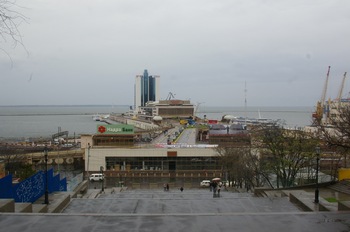
That wasn't in the movie.
Plus the city had by repute wonderful Art Nouveau architecture. Plus I had never seen the Black Sea before. If I was genuinely stranded for some time, I could perhaps see Crimea, and the Black Sea coast of Romania. And the Black Sea coast of Bulgaria. And even if I was delayed a few days, I could stop in Moldova as I headed back to Poland. I try to visit one at least profoundly weird place each year, and Transnistria would be a good one for this year.
However, none of this eventuated. Flights resumed just in time for my scheduled trip home. On April 21 I found myself needing to be in Katowice in 27 hours. Thus I boarded the train to Lviv.
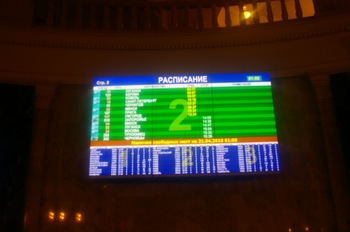
There are three classes of ticket for overnight trains in the former USSR. The cheapest, 3rd class, is called platzkart. Platzkart carriages contain 54 beds. There is very little privacy, inadequate toilent facilities, and travelling platzkart has a certain reputation. ("The basic layout is essentially a copy of the old slave ships, or perhaps the GULAG camps"). However, travelling this way is very cheap. 2nd class is kupe. Carriages contain 9 compartments, each containing four beds, with an upper and lower bunk on either side of the compartment. There is more privacy, and more comfort and space. Tickets cost about twice the cost of platzkart - for a journey from Odessa to Lviv my kupe ticket cost the equivalent of about £10. 1st class is spalny wagon, which consists of compartments containing two beds each. This costs three or four times as much as kupe - not hugely expensive by western European standards, but a considerable premium. So, I choose kupe. I bought a ticket to Lviv. Even this is not always easy when timetable information in the station is entirely in Cyrillic, you have no common languages with the railway staff, and the very badly paid staff themselves received their customer service training in the Soviet Union. But I managed it.
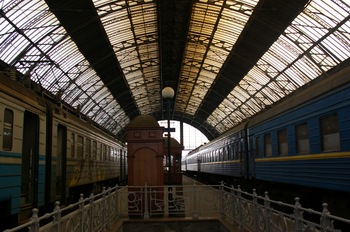
Of course, in a kupe carriage, you share a compartment with three other people, and it is luck as to who you get. I prepared myself for the journey. The custom on long Eastern European train journeys is for passengers in the same train compartment to have something resembling a picnic in the compartment. People pack food - often things like cheese, bread, and cold meats - and these things are shared at meal times. I went to a shop near the main train station and purchased some bread, cold sausage, cheese, and tinned fish, and was prepared for a little socialising if the people sharing the compartment were friendly. I also made sure I had a charged laptop with a spare battery, the previous evening's episode of Lost on the hard disk, an assortment of movies, and a couple of good books.
So I was ready. I boarded the train and was guided to my compartment. There were three other people with me: a respectable looking married couple about my own age, and a younger man. I sat down. The younger man insisted on speaking to me and the other passengers incessantly in Russian. There was a lot of beer, vodka, and a few inscrutable food items on the table. His breath smelled of something including but not limited to beer. He insisted on talking incessantly for the half hour or so I sat there with the two other. The married couple sat there largely in silence with rather stern expressions on their faces, although the husband greeted me in accented but quite decent English.
After about a half hour of this, the married couple got up departed the compartment. The younger drunk Russian stayed for a bit longer, and attempted to get me to share his beer. After a while I perhaps foolishly took a swig. A few minutes after this, he attempted to get me to share the marijuana he had stashed in his sock. He wasn't just drunk. I declined on the marijuana. After a time he also got up and left the compartment. (Yes, he was probably Ukrainian rather than Russian, but as a state of mind, one enters Russia when one gets on a train anywhere in Russia, Ukraine, or Belarus. One just does).
Not long after this, the husband (but not the wife) of the other couple returned. As it happened he spoke very decent English: accented when he spoke but his comprehension was excellent; the sort of English that someone has when he has spent time working in places and environments where it is useful to be able to speak English and where it has been picked up along the way. He asked me where I was from. When I told him I was Australian he commented that my English was easy to understand. Many Australians speak heavily accented and idiomatic English, but I didn't. I spoke heavily accented and idiomatic English for a couple of sentences, and we both laughed. He told me about his travels in the Middle East and Asia. We compared notes on Dubai and Malaysia. He seemed a nice bloke - exactly the sort of company one hopes for in a train in a foreign country.
However, this was not to last. His wife soon returned and they had a discussion in Russian. I was told that they were going to a compartment in another carriage, as "he" would undoubtedly return soon, and they needed to get some rest. I was not unsympathetic to their point of view, but I was not pleased by this development. Given the choice of sharing a compartment with two sensible people and a drunk and stoned Russian nutter, or with just a drunk and stoned Russian nutter, I knew which I preferred. This clearly showed on my face. My English speaking friend translated one last phrase from his wife, directed at me. "Good Luck".
Of course, I was not expecting good luck, and I did not get it. My drunk and stoned friend returned a while later. By this time I had settled down on my top bunk with a book, but he still wanted my attention. More incessant speaking. Attempts to slap my hand with his hand. Attempts to shove beer and vodka in my direction, followed by more incessant talking and unpredictable reactions when I refused. After about half an hour of this, he departed again, thankfully.
In order to comprehend the full experience of the rest of this journey, more of the customs of Russian train travel need to be revealed. Firstly, each carriage has a provodnitsa (provodnik if male, but they usually seem to be female) who is an attendant who checks tickets, provides bed linen, cleans compartments, offers coffee at the start and end of the journey, and is generally in charge of the carriage. Secondly, overnight trains make long stops. At a major station the train may stop for up to an hour in the middle of the night. When this happens, vendors selling food, drink, and other items appear on the platforms of the station, and passengers often get off to buy items from them.
Consequently, my journey developed a rhythm. My obnoxious friend would come into the carriage and irritate me for half an hour or more, before getting restless. At that point, he would vanish to somewhere else on the train for a time. If there was a stop, he would clearly leave the train. Shortly afterwards, he would reappear in the compartment with various items, and would talk incessantly in Russian and would thrust whatever he had bought in my face, and perhaps attempt to high-five me again.
What can I say? Having two smoked fish and a bottle of Ukrainian beer thrust in your face at midnight when you are trying to sleep is one of those things that is perhaps better to write about later than to experience at the time, although admittedly it does make for a good story later.
The next phase in the rhythm would be that the items that had been purchased on the platform at the stop would be placed on the table in the compartment, and my obnoxious friend would again get restless and wander to somewhere else in the train. At that point the provodnitsa (who was aware she had a problematic passenger) would come into the department and take away all the beer, vodka, illicit drugs, smoked fish etc that were on the table. There was no direct confrontation - just a sort of attempt to moderate the problem. In one of these intervals I got my laptop out, and managed to watch Lost. I pulled the memory card out of my camera, and was just starting to sort out my holiday snaps when my friend returned, so I put the laptop away as I did not know how he would respond. Similarly, I was reluctant to get out my own food, as I did not know whether he would demand some as part of Russian train etiquette, or any of a number of other weird reactions.
At about 1am, the provodnitsa came in, made my obnoxious friend's bed, and then clearly went somewhere else and encouraged him to come back to the compartment. She then spoke to him for what seemed like about an hour in the sort of way a particularly patient mother would speak to a particularly troublesome small boy. I could only think, what a horrible job. If you behaved like this on a train in western Europe, you would be thrown off the train at the next station, and likely be greeted by police who would take you off and throw you in a cell. However, in the Ukraine, the only power apparently available to the provodnitsa is to attempt to pacify the passenger. She has apparent authority, but is backed up by very little power or actual authority.
In any event it didn't really work, for after she left, so did my obnoxious friend, and his cycle of going, coming back and being annoying continued. I was concerned that at some point he would vomit and/or urinate, but thankfully this did not happen, a small mercy I suppose.
At about 3am, after yet one more such incident, I finally lost my temper. After another attempt to gain my attention, slap hands with me, and share beer with me from my friend, I got up and swore at him, loudly and in English. I cursed him. I cursed his mother. I cursed his country. I expressed the view that the Mongol sacking of Kiev in 1240 had been not nearly comprehensive enough for my liking. I managed to use pretty much every obscenity in the English language that is not a racial epithet. I responded to being slapped by slapping back. He made a gesture suggesting I join him in the corridor outside, but nothing came of that.
And oddly enough, soon after that he did finally go to bed again and fall asleep. I got a little sleep myself, too, but it was only a few hours to our arrival in Lviv at 7am. The provodnitsa woke us at that point. My obnoxious friend at this point insisted on buying me a cup of coffee, and shaking my hand as he left the carriage.
However, when I left the carriage, I was shattered. I had hoped for a restful night, and I hadn't got one. I walked off the train, and it was very cold. I sort of struggled to the nicest lounge in the railway station - the one with the admission charge and Wifi. I sat down and had a coffee. After a while I got out my laptop and attempted to check train times. After a bit of struggling with websites, I discovered that there were two trains a day from Lviv to Przemyśl on the other side of the Polish border, one at 23.59 and the other at 7.18. It was about 8.00am. I could have made the 7.18 after arriving in Lviv, but I had been too shattered to think about it at the time.
Actually, it was worse than that. Some of the carriages on that 7.18 had actually come from Odessa, on another train that had departed there at 6.13pm the previous evening. I could actually have gone to Przemyśl directly from Odessa. But, as I said, figuring out the timetables in Cyrillic had not been easy.
On the other hand, two trains a day. That Silesian corridor between Lviv and Wrocław was once one of the centres of the Austrian and then Prussian empires - one of the most advanced and populous areas of central Europe. Now, two trains a day.
But of course there were road options to get to Przemyśl, and I still had 13 hours in which to get to Katowice. It was only 400km. The main bus station in Lviv, was, however, about 8km south of the city centre. I could get there by getting a couple of trams. I got one to the centre of Lviv. Another would get me to the bus station. It seemed my best bet.
However, after the first tram, still shattered. I passed a cafe where I knew there was power, Wifi, more coffee, and a good breakfast to be had. I went in.
Over breakfast, more googling. Websites suggested that entering Poland from Ukraine could be difficult, and that buses could be delayed "up to nine hours". Other websites suggested that crossing the border on foot could be a good deal faster, if you had an EU or other rich country passport. Also, it was possible to get a marshrutki - a privately owned minibus that goes when it has enough passengers and stops when and where passengers ask - what transport nerds in other countries call a jitney - to Shehyni (Шегині). Of course, this went from the main train station. I therefore got another tram back to the station, and after wandering around for a bit found the marshrutki with "Шегині" on the front.
The ride to the border took an hour and a half. We went down an adequate road with a major European route number through many picturesque towns with beautiful churches and agriculture. There were many horse drawn vehicles, and fields being ploughed with animal and human labour nearby. This place is poor. Still, I was moving in the right direction. One of the cardinal rules of the ancient Confucian art of going with the flow (travel version) is to take any opportunity to move in the right direction, and I was moving in the right direction. I was concerned that I was going to have difficulty crossing the border.
As it happened, no problem. I got to Shehnyi. The queue to cross the border by road was extremely long and slow. The border features a lot of fencing and barbed wire, with a no man's land in the middle. This is an external border of the EU and of the Schengen area. This is a serious rich/poor border. 20 years after the end of communism, Poland is in many ways a fairly normal western country. Ukraine, not.
I walked across. Immigration turned out to be childishly simple, for me, anyway. As at many European borders, there were two lanes, one for "EU, Swiss and other EEA passports", and one for "Other passports". They may as well have just said "Poles", and "Ukrainians", or even "Rich", and "Poor". I was traveling on my British passport, so I walked down the EU line, which took me straight to the front of the line. The "non-EU" line was long and slow. My hunch is that if I had produced my Australian passport or an American or even a Brazilian passport, I would have been directed down the "EU" line. The global apartheid that allows people born in some places to move freely and people born in others to not move freely was as starkly evident has as anywhere I have seen. In truth, this was the starkest Rich/Poor border I have ever seen. Last time I crossed the Mexico/US border on foot I was made to queue like anyone else. American border guards go for equal opportunity humiliation, and that is perhaps fairer, if less convenient to me.
However, having gone through immigration, I still had to go through customs, and that was what this was all about. The entire purpose of this checkpoint is to prevent people smuggling cigarettes. Everyone crossing the border was getting their luggage searched. Everyone was carrying two packets of cigarettes - 40 cigarettes in total.
As it happened, this was perhaps a problem for me, as I was carrying 200 cigarettes. I occasionally bring cigarettes back to the UK for Thaddeus Tremaine, on the basis that they are much cheaper in many of the places I visit than they are in the UK. I had bought some in the Ukraine for him, and had assumed I would be able to bring the 200 cigarettes I am permitted when I enter the EU by air. I suddenly had a problem.
I decided that I would try the "Who, me? I am British." trick. The cigarettes were in the bottom of my rucksack. The official asked me "Cigaretten?" or something similar in something resembling German. It was clear he did not have much English. I could say "yes", and be asked how many, or I could say "no". However, that would be lying, and in such situations it is very important not to lie, as this can lead to trouble. Therefore, I instead said "Only a few" in the hope that he would not understand. This worked, but he still gestured for me to open my bag. I opened the compartment with my dirty underwear and socks in it. That worked well, and he gestured for me to close the bag without further checks. I walked on.
I was in the border crossing at the small Polish town of Medyka. Border crossing points are like military bases - they have the same shabby prefabricated look worldwide. This was no exception. There was a small supermarket, a few bars, some shabby shops selling vaguely Eastern European themed trinkets, money changers, etc.
One thing that was relatively unique to here was that there were a large number of elderly Ukrainian women, all holding two packets of cigarettes and one bottle of vodka to people who walked past. The Ukrainian side of the border was so poor that it was worth these women's while to queue for three hours in the cold in order to make a profit consisting of the difference between Ukrainian and Polish taxes on two packets of cigarettes and one bottle of vodka. These things are not expensive in Poland. The profit for such a journey would be less than $5 - possibly a good deal less. Middle aged and elderly women are the people who hold the country together - I saw this on the train and in many other places - and I felt a certain sympathy that comes from getting a poor lot in life.
I did something impulsive. I walked up to the nearest of these women, and simply handed her the relatively small amount of Ukrainian currency I had in my wallet. This was not much - the equivalent of six or seven dollars - but I just felt like doing it. She looked at me with surprise, but took the money.
However, ten minutes later, I realised that had not perhaps been a great idea. I had very little other money of any kind on me, and there were no cash machines near the border. There were plenty of money changers, but that was all. And there was no frequent transport - no jitneys here. Being a modern western country means that the state runs (or at least regulates) public transport, so obviously it is a lot worse. There were a few white minibuses carrying workers of various kinds to pre-arranged destinations. I could probably have done a deal with one of these people to take me to Przemyśl, but I had no cash. This was still insurmountable - "Take me to a cash machine in Przemyśl and I will then pay you" can be communicated, but these people spoke little English and it was relatively difficult to communicate. It would have been easier to have just held up some banknotes and asked "How much". If I had kept the Ukrainian money, I would have been able to change it to Zloty and I would have had less of a problem. However, I hadn't.
I did have about four Zloty ($1.20) on me, however, and there was a municipal bus, but it only came once every couple of hours. So I waited. I had no money, but (as it happened) I had some cold sausage, bread, cheese, and tinned fish with me, so I made myself lunch.
In a way this was worth it, because in that time, I saw something. A black van pulled up near the border. The black van was mobbed by elderly white haired Ukrainian women, thrusting their cigarettes and vodka through the windows, and being handed small sums of money. This went on for about sixty seconds. At this point another van, with some sort of official logo and flashing lights on top pulled up and honked its horn. The elderly Ukrainian women dispersed. There was no attempt to detain or arrest anyone - merely to stop the women onselling their cigarettes. The black van drove slowly off. I gave the driver the thumbs up. He smiled.
It was better than that, though. As this went on, the skies opened and snow fell. I felt like I was in a cold war movie.
I waited the hour and a half. The bus came. I had soon traveled the 10km to Przemyśl Glowny railway station, noticed that there was a train going to Wrocław at 13.42. Great. Everything was under control. I might even have the chance to quickly visit the Katyn memorial in Katowice before heading for the airport. I bought a ticket. The ticket seller was a helpful young woman who looked like she was paid reasonably and had decent working conditions. I had about 45 minutes. I went from a brief walk around Przemyśl: another of those nice central European cities. Nice church. Nice square. You could spend a nice couple of days here. I found a cash machine, and a bar, and ordered a Żywiec. The beer was good and cold. Seldom have I enjoyed one more.
I got out my laptop and my camera. My hand brushed across the side of the laptop, and felt a memory card sticking out. I swore. I had put the laptop away hurriedly when the drunk Russian returned to my compartment in the middle of the night, and I had not returned the memory card to the camera. Thus the photographs of the border and its barbed wire, long and short queues, and the snow falling on the cigarette smugglers had not been saved. (Just why my otherwise splendid camera pretends to take photographs when it has no card, I do not know). I did not swear as savagely as I had in the middle of the night, but I swore a little bit.
Still, that was life. Things like this happen occasionally. It was still a good story. I have borrowed a couple of photographs that I did not take myself for this part of the journey, but the loss of the photograph of the two vans, one being mobbed by elderly Ukrainian women in the snow is a shame.
I boarded my train.
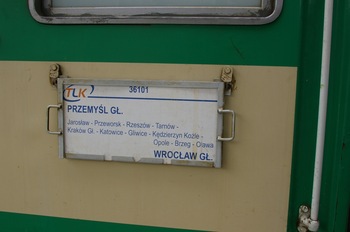
There were way more stops than this. False advertising.
Soon, I realised that this train was not going quickly. Still, I had five and a half hours, and the distance was less than 300km. Not to worry. On the other hand, I was starting to wish I had checked the arrival time of the train in Katowice. And there was clearly no way I was getting to the Katyn memorial. Still, the train plodded along. It may have been quicker to get the bus, as Poland has spent more money on roads than railways since freedom. Eventually, though, we got to Krakow, At 5.30pm. There was still no problem if we were in Katowice by 7.00pm, and it was only 80km. I was getting a bit nervous, but it still seemed doable. I knew there was a bus service from Krakow to Katowice airport, but I did not know the times. The road from Krakow to Katowice is extremely good (this is the most densely populated area in Poland), and the bus would get me there pronto, but I did not know if there was one at the right time, so I stayed on the train. There was a bus every half hour from Katowice to Katowice airport, and I would surely be there in time. In the worst case scenario I could get a taxi.
Short as the last section of the journey was and important as the city pair was, the journey was really not fast. A nice girl of about 20 carrying a case containing a stringed instrument got into my compartment at Krakow. Her boyfriend helped her onto the train with her luggage, kissed her and seemed to wish her luck in Wrocław, and left the train. I said hello in English and she smiled and greeted me warmly back. She studied sheet music as the train went on. Wrocław contains a particularly beautiful concert hall. I imagined for a moment that she was going there to play, but she probably wasn't.
The journey from Krakow to Katowice is a strange one. The first section is in beautiful rolling hills in the valley of the river Vistula. Krakow itself is a heartbreakingly beautiful city. The train on the next platform was going to Oświęcim, a place better known outside Poland by its German name, and another reminder of the terrible history of this part of Europe.
The train then goes through the Upper Silesian Metropolitan Area, the largest metropolis in Poland. This is an industrial heartland that was built by the Prussians and Germans, and then later run in that delightful way that communist governments ran industry. In 1989 it was one of the most polluted places on earth. Poles from elsewhere still make faces and express puzzlement when you say you have been there.
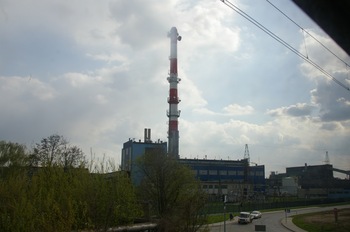
Now though, it is a strange mixture of industrial, urban, and other. You pass through one centre of communist housing, then you pass the somewhat desolate (but recovering) forest, then an older town with a beautiful church, then a coal mine, then repeat, not necessarily in the same order. As you approach Katowice itself, the urban sections get larger. Katowice itself contains international hotels, shopping streets, bars and restaurants, small shops, large malls, and all the things you find in a civilized urban environment. It is a modern western city. I rather like it.
But there was no time to like it in this instance. The Upper Silesian metropolitan area is a federation of 14 cities, and the train seemingly stopped at all of them, traveling very slowly between. Eventually we got to Katowice station. I wished the nice musician girl a good day and sprinted off the train. I went to another cash machine and withdrew money for cab fare. The bus to the airport was due to depart in a few minutes. It was a nice modern bus, and would generally have been a highly efficient way of getting to the airport, but it was 7.35pm, my flight departed at 8.25pm, and I had no idea how chaotic the airport was going to be, given that this was the first flight to London in a week. Ryanair had stated that gates would close 40 minutes before departure rather than the normal 30, and although the 30 is not normally enforced if you have checked in online, I had no idea what the situation would be. Given I was rushing for my original scheduled flight that had not been cancelled, I was concerned that the consequences would be severe if I missed it. Perhaps I would have to wait for days for another flight with a seat. And I had no idea how much I would be charged if so.
So I jumped into a taxi and asked the driver to take me to the airport. The taxi was a new silver Mercedes. Katowice airport is about 55km from the centre of the city (although it is in the metropolis). There are motorways all the way. The driver instantly realised that I was in a hurry (or perhaps he just liked driving his silver Mercedes fast, as this is what it was designed for), so we sped down the motorway. I watched the meter tick over at high speed. 50 Zloty. 100 Zloty. 150 Zloty. This was as expensive as taking an equivalent taxi journey in Germany. Poland is generally cheap, but if you behave like a rich European you will be charged like a rich European, and that includes staying in an international hotel of getting a Mercedes taxi to the airport. 200 Zloty. 250 Zloty. 300 Zloty.
And it was still a bit more than that when we got to the airport. (And yes, subsequent research indicates that this is several times what that journey should have cost. This does not encourage me to use more taxis in Poland in future. However, I was in such a hurry that there was not a lot I could do about it). But we got there, at about 8pm. The success of a journey of 27 hours had ended up coming down to a frantic last fifteen minutes. I had not withdrawn enough money, so I rushed to another cash machine, went back and paid the driver, went through security, and got my belt horribly caught in my trousers as I desperately tried to take it off to put it through the X-Ray machine.
At that point, though, the security guy made a gesture that translated roughly as "Relax". He could see my flight boarding in the distance, and there was still a queue and there was really no trouble making the gate in time. I didn't quite relax, but I slowed down. A Polish immigration guy scanned my passport. I walked to the gate and boarded the plane. At this point I could relax. I would be asleep in my own bed that evening. As I was.
It was a stressful but interesting journey. And it ended well. I could have done without the taxi fare at the end (which, incidentally, cost more than the train from Odessa to Lviv, the marshrutki to the Polish border, the bus to Przemyśl, the train to Katowice, the flight to London, the train from Stansted Airport to London, and the bus from Liverpool St Station to my home, put together). But one is hit by an unexpected expense once in a while, and the taxi driver got me to my flight, for which he has my thanks.
Still, though, at 6pm on April 21, I was not too worried. I had 27 hours to get from Odessa to Katowice airport. In a way, I was slightly disappointed, because Crimea and Moldova were both within reach, both
were intriguing destinations, and I had no particularly pressing business in London before May 2. However, I had a confirmed seat on the flight on the 22nd, and I was unsure what the consequences would be if I missed it. Thus I did not want to miss it.
There was an overnight train to Lviv leaving at 7pm. I purchased a second class ("kupe") sleeper ticket for this train. I would figure out the rest of the journey when I reached Lviv.
As it happened, there is no need for suspense. I did ultimately make the flight home. At midnight (London time) on April 22nd, I was in my own bed in my flat in London. The story of what happened in between is, however, a peculiar one, involving well traveled Russians, less well traveled Russians, alcohol, cannabis, smoked fish (none of these mine), jitneys, agriculture with animal pulled ploughs, external borders of the Schengen area, snow, cigarette smuggling (some of this mine), helpful Polish bus drivers, poor Polish trains and good Polish motorways, and a very expensive, frantic and fast last minute taxi ride, in which the success or failure of a 27 hour journey all came down to five minutes. This post is the story of that journey. However, before anything else I need to explain the circumstances that led me to be in Odessa on that Wednesday afternoon in the first place. Let me digress for a few paragraphs.
I visited Eastern Ukraine, specifically Kiev, last year. In Kiev, I received lots of advice that I should also visit Lviv, on the basis that it is a beautiful city. Mixed in with this was the suggestion that Lviv was somehow more "authentically Ukrainian" than Kiev, Kiev being more Russian (or perhaps Russia being more Kievan). Certainly parts of Kiev last year did have some of the nouveau riche flashiness of over-blinged people going into nightclubs and badly built modern apartment blocks that were constructed in a recent construction boom that had just horribly flamed out that I at least associate with recent years in Moscow and St Petersburg. And Kiev is full of the architecture a westerner imagines when he hears the word "Russian".
That was one factor. Another was that until recently I had not visited the Balkans and South-Eastern Europe much. However, a trip to Bulgaria (mixed with the important "Where can I get a cheap flight to this week?" ie luck factor) a couple of years ago led to another trip to Bulgaria, a couple of trips to Romania, and a couple of trips to Croatia. Suddenly I found myself visiting the remains of the Austrian Empire, and of course the region where empires (Austrian, Ottoman, Lithuanian, Polish, Russian) for a long time collided. In six months I visited Wrocław (not Austrian since 1740s, but you can feel the Austria in the cafes), Sibiu and Cluj-Napoca, and then the Austrians' favourite Adriatic seaside resort of Opatija, now in Croatia but once again you can still feel the Austria. All these places are in different countries, but you can feel the common history in the architecture, the food, the coffee, and the beer. Lviv (then Lemberg) was once a great city of that Austrian empire. This was a central city of that great cultural and intellectual explosion that followed Jewish emancipation in the 19th century, and then of course later this was pretty close to the centre of the unspeakable mass murder of the Holocaust. Just why the supposedly civilized heart of Europe felt the need to tear itself apart in such an unspeakable way, I don't really know. And just how the birthplace of Ludwig von Mises managed to be ruled by the Soviet Union for 50 years is another of those great mysteries and ironies of Europe and the twentieth century.
So, that made two reasons to go to Lviv. When I have two different reasons to go to a place, it goes to the top of my destination list. As it happens, there are no direct flights from London to Lviv. One can get there on discount airlines if one is willing to change in Dortmund, or in Timişoara, or in Kiev, but the change leads to expense and hassle. Alternately, Lviv is not far from the modern day Polish border. One can fly to Poland and get the train. Flying to Poland is easy.
The nearest Polish city with an airport is Rzeszów. I was able to get a cheap ticket to Rzeszów on April 13, but tickets back were more expensive. I was not in any particular hurry to get back, and I discovered that Ryanair would give me a ticket back from Katowice on April 22 that was very cheap. Katowice was further into Poland, but I had a couple of things in that part of Poland that I wanted to do. The Czartoryski Museum in Krakow was closed when I attempted to visit it last year, and it would be nice to stop in and see its great collection. Plus, I wanted to make a second visit to Katyn memorial in Katowice, that I previously visited in 2007. Since then I have learned more Polish history, which would perhaps make my reaction different than then. Secondly, although the bulk of what was lost in my sad hard drive failure have been recovered from various backups, those from that trip are some of the sad lost photographs, and I wanted to retake some of them. So, although traveling to Katowice involved further travel, there were enough reasons to do this travel that I did not mind too much.
However, events overtook me. Polish president Lech Kaczyński and his large entourage including most of the General Staff of the Polish armed forces, the central bank governor, and many other senior Polish officials died in a plane crash near Katyn two days before I was due to arrive in Poland. I spent a day in Rzeszów. The people of Poland were clearly enormously upset by what had happened, but life went on. Since 1989 Polish policy has been aggressively pro-Western, and Poland is now a modern, sensible, stable country. I bought a charger for my laptop in a large Tesco store. Not far from this were outlets of the two French hypermarket chains Carrefour and Leclerc, along with other stores. Lines of succession to the Polish presidency, central bank governorship and military command were all clear, and everything worked well. Poland is modern, stable, and relatively prosperous, and the country was having nothing remotely resembling a crisis.
However, the country was in national mourning. It felt almost like intruding on someone else's grief. I headed for the Ukraine. I had a number of good days in Lviv. The city looks like a central European city rather than a Russian city, although it is alas now one of the poorest of all central European cities. The Austrian influence is once again strong. The beer is superb, but the wine terrible. Lviv is a city of churches. Christians there have many choices, with there being about six major forms of Christianity to choose from, three in communion with Rome and three not. Lviv was once also no doubt a city of synagogues, but (alas) we know what happened there. I enjoyed the visit, but this is not what I am presently trying to write about.
I had been a few days in Lviv. European airspace was closed, President Kaczyński's funeral was going to be in Krakow and half the leaders of the world might or might not be attending. In any event, Googling I should have done before booking my flight indicated that the Czartoryski Museum was still closed. It appeared it might be weeks before I could get home. So, I changed my mind about where I was headed, and went further east. A Czech had recommended I visit Odessa while I was in Chernobyl last year, plus I am a cinema buff, and for a cinema buff there are famous things to see in Odessa.
I was hoping there would be pram rental somewhere nearby
That wasn't in the movie.
Plus the city had by repute wonderful Art Nouveau architecture. Plus I had never seen the Black Sea before. If I was genuinely stranded for some time, I could perhaps see Crimea, and the Black Sea coast of Romania. And the Black Sea coast of Bulgaria. And even if I was delayed a few days, I could stop in Moldova as I headed back to Poland. I try to visit one at least profoundly weird place each year, and Transnistria would be a good one for this year.
However, none of this eventuated. Flights resumed just in time for my scheduled trip home. On April 21 I found myself needing to be in Katowice in 27 hours. Thus I boarded the train to Lviv.
There are three classes of ticket for overnight trains in the former USSR. The cheapest, 3rd class, is called platzkart. Platzkart carriages contain 54 beds. There is very little privacy, inadequate toilent facilities, and travelling platzkart has a certain reputation. ("The basic layout is essentially a copy of the old slave ships, or perhaps the GULAG camps"). However, travelling this way is very cheap. 2nd class is kupe. Carriages contain 9 compartments, each containing four beds, with an upper and lower bunk on either side of the compartment. There is more privacy, and more comfort and space. Tickets cost about twice the cost of platzkart - for a journey from Odessa to Lviv my kupe ticket cost the equivalent of about £10. 1st class is spalny wagon, which consists of compartments containing two beds each. This costs three or four times as much as kupe - not hugely expensive by western European standards, but a considerable premium. So, I choose kupe. I bought a ticket to Lviv. Even this is not always easy when timetable information in the station is entirely in Cyrillic, you have no common languages with the railway staff, and the very badly paid staff themselves received their customer service training in the Soviet Union. But I managed it.
Of course, in a kupe carriage, you share a compartment with three other people, and it is luck as to who you get. I prepared myself for the journey. The custom on long Eastern European train journeys is for passengers in the same train compartment to have something resembling a picnic in the compartment. People pack food - often things like cheese, bread, and cold meats - and these things are shared at meal times. I went to a shop near the main train station and purchased some bread, cold sausage, cheese, and tinned fish, and was prepared for a little socialising if the people sharing the compartment were friendly. I also made sure I had a charged laptop with a spare battery, the previous evening's episode of Lost on the hard disk, an assortment of movies, and a couple of good books.
So I was ready. I boarded the train and was guided to my compartment. There were three other people with me: a respectable looking married couple about my own age, and a younger man. I sat down. The younger man insisted on speaking to me and the other passengers incessantly in Russian. There was a lot of beer, vodka, and a few inscrutable food items on the table. His breath smelled of something including but not limited to beer. He insisted on talking incessantly for the half hour or so I sat there with the two other. The married couple sat there largely in silence with rather stern expressions on their faces, although the husband greeted me in accented but quite decent English.
After about a half hour of this, the married couple got up departed the compartment. The younger drunk Russian stayed for a bit longer, and attempted to get me to share his beer. After a while I perhaps foolishly took a swig. A few minutes after this, he attempted to get me to share the marijuana he had stashed in his sock. He wasn't just drunk. I declined on the marijuana. After a time he also got up and left the compartment. (Yes, he was probably Ukrainian rather than Russian, but as a state of mind, one enters Russia when one gets on a train anywhere in Russia, Ukraine, or Belarus. One just does).
Not long after this, the husband (but not the wife) of the other couple returned. As it happened he spoke very decent English: accented when he spoke but his comprehension was excellent; the sort of English that someone has when he has spent time working in places and environments where it is useful to be able to speak English and where it has been picked up along the way. He asked me where I was from. When I told him I was Australian he commented that my English was easy to understand. Many Australians speak heavily accented and idiomatic English, but I didn't. I spoke heavily accented and idiomatic English for a couple of sentences, and we both laughed. He told me about his travels in the Middle East and Asia. We compared notes on Dubai and Malaysia. He seemed a nice bloke - exactly the sort of company one hopes for in a train in a foreign country.
However, this was not to last. His wife soon returned and they had a discussion in Russian. I was told that they were going to a compartment in another carriage, as "he" would undoubtedly return soon, and they needed to get some rest. I was not unsympathetic to their point of view, but I was not pleased by this development. Given the choice of sharing a compartment with two sensible people and a drunk and stoned Russian nutter, or with just a drunk and stoned Russian nutter, I knew which I preferred. This clearly showed on my face. My English speaking friend translated one last phrase from his wife, directed at me. "Good Luck".
Of course, I was not expecting good luck, and I did not get it. My drunk and stoned friend returned a while later. By this time I had settled down on my top bunk with a book, but he still wanted my attention. More incessant speaking. Attempts to slap my hand with his hand. Attempts to shove beer and vodka in my direction, followed by more incessant talking and unpredictable reactions when I refused. After about half an hour of this, he departed again, thankfully.
In order to comprehend the full experience of the rest of this journey, more of the customs of Russian train travel need to be revealed. Firstly, each carriage has a provodnitsa (provodnik if male, but they usually seem to be female) who is an attendant who checks tickets, provides bed linen, cleans compartments, offers coffee at the start and end of the journey, and is generally in charge of the carriage. Secondly, overnight trains make long stops. At a major station the train may stop for up to an hour in the middle of the night. When this happens, vendors selling food, drink, and other items appear on the platforms of the station, and passengers often get off to buy items from them.
Consequently, my journey developed a rhythm. My obnoxious friend would come into the carriage and irritate me for half an hour or more, before getting restless. At that point, he would vanish to somewhere else on the train for a time. If there was a stop, he would clearly leave the train. Shortly afterwards, he would reappear in the compartment with various items, and would talk incessantly in Russian and would thrust whatever he had bought in my face, and perhaps attempt to high-five me again.
What can I say? Having two smoked fish and a bottle of Ukrainian beer thrust in your face at midnight when you are trying to sleep is one of those things that is perhaps better to write about later than to experience at the time, although admittedly it does make for a good story later.
The next phase in the rhythm would be that the items that had been purchased on the platform at the stop would be placed on the table in the compartment, and my obnoxious friend would again get restless and wander to somewhere else in the train. At that point the provodnitsa (who was aware she had a problematic passenger) would come into the department and take away all the beer, vodka, illicit drugs, smoked fish etc that were on the table. There was no direct confrontation - just a sort of attempt to moderate the problem. In one of these intervals I got my laptop out, and managed to watch Lost. I pulled the memory card out of my camera, and was just starting to sort out my holiday snaps when my friend returned, so I put the laptop away as I did not know how he would respond. Similarly, I was reluctant to get out my own food, as I did not know whether he would demand some as part of Russian train etiquette, or any of a number of other weird reactions.
At about 1am, the provodnitsa came in, made my obnoxious friend's bed, and then clearly went somewhere else and encouraged him to come back to the compartment. She then spoke to him for what seemed like about an hour in the sort of way a particularly patient mother would speak to a particularly troublesome small boy. I could only think, what a horrible job. If you behaved like this on a train in western Europe, you would be thrown off the train at the next station, and likely be greeted by police who would take you off and throw you in a cell. However, in the Ukraine, the only power apparently available to the provodnitsa is to attempt to pacify the passenger. She has apparent authority, but is backed up by very little power or actual authority.
In any event it didn't really work, for after she left, so did my obnoxious friend, and his cycle of going, coming back and being annoying continued. I was concerned that at some point he would vomit and/or urinate, but thankfully this did not happen, a small mercy I suppose.
At about 3am, after yet one more such incident, I finally lost my temper. After another attempt to gain my attention, slap hands with me, and share beer with me from my friend, I got up and swore at him, loudly and in English. I cursed him. I cursed his mother. I cursed his country. I expressed the view that the Mongol sacking of Kiev in 1240 had been not nearly comprehensive enough for my liking. I managed to use pretty much every obscenity in the English language that is not a racial epithet. I responded to being slapped by slapping back. He made a gesture suggesting I join him in the corridor outside, but nothing came of that.
And oddly enough, soon after that he did finally go to bed again and fall asleep. I got a little sleep myself, too, but it was only a few hours to our arrival in Lviv at 7am. The provodnitsa woke us at that point. My obnoxious friend at this point insisted on buying me a cup of coffee, and shaking my hand as he left the carriage.
However, when I left the carriage, I was shattered. I had hoped for a restful night, and I hadn't got one. I walked off the train, and it was very cold. I sort of struggled to the nicest lounge in the railway station - the one with the admission charge and Wifi. I sat down and had a coffee. After a while I got out my laptop and attempted to check train times. After a bit of struggling with websites, I discovered that there were two trains a day from Lviv to Przemyśl on the other side of the Polish border, one at 23.59 and the other at 7.18. It was about 8.00am. I could have made the 7.18 after arriving in Lviv, but I had been too shattered to think about it at the time.
Actually, it was worse than that. Some of the carriages on that 7.18 had actually come from Odessa, on another train that had departed there at 6.13pm the previous evening. I could actually have gone to Przemyśl directly from Odessa. But, as I said, figuring out the timetables in Cyrillic had not been easy.
On the other hand, two trains a day. That Silesian corridor between Lviv and Wrocław was once one of the centres of the Austrian and then Prussian empires - one of the most advanced and populous areas of central Europe. Now, two trains a day.
But of course there were road options to get to Przemyśl, and I still had 13 hours in which to get to Katowice. It was only 400km. The main bus station in Lviv, was, however, about 8km south of the city centre. I could get there by getting a couple of trams. I got one to the centre of Lviv. Another would get me to the bus station. It seemed my best bet.
However, after the first tram, still shattered. I passed a cafe where I knew there was power, Wifi, more coffee, and a good breakfast to be had. I went in.
Over breakfast, more googling. Websites suggested that entering Poland from Ukraine could be difficult, and that buses could be delayed "up to nine hours". Other websites suggested that crossing the border on foot could be a good deal faster, if you had an EU or other rich country passport. Also, it was possible to get a marshrutki - a privately owned minibus that goes when it has enough passengers and stops when and where passengers ask - what transport nerds in other countries call a jitney - to Shehyni (Шегині). Of course, this went from the main train station. I therefore got another tram back to the station, and after wandering around for a bit found the marshrutki with "Шегині" on the front.

The ride to the border took an hour and a half. We went down an adequate road with a major European route number through many picturesque towns with beautiful churches and agriculture. There were many horse drawn vehicles, and fields being ploughed with animal and human labour nearby. This place is poor. Still, I was moving in the right direction. One of the cardinal rules of the ancient Confucian art of going with the flow (travel version) is to take any opportunity to move in the right direction, and I was moving in the right direction. I was concerned that I was going to have difficulty crossing the border.
As it happened, no problem. I got to Shehnyi. The queue to cross the border by road was extremely long and slow. The border features a lot of fencing and barbed wire, with a no man's land in the middle. This is an external border of the EU and of the Schengen area. This is a serious rich/poor border. 20 years after the end of communism, Poland is in many ways a fairly normal western country. Ukraine, not.
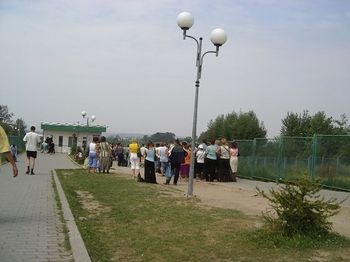
I walked across. Immigration turned out to be childishly simple, for me, anyway. As at many European borders, there were two lanes, one for "EU, Swiss and other EEA passports", and one for "Other passports". They may as well have just said "Poles", and "Ukrainians", or even "Rich", and "Poor". I was traveling on my British passport, so I walked down the EU line, which took me straight to the front of the line. The "non-EU" line was long and slow. My hunch is that if I had produced my Australian passport or an American or even a Brazilian passport, I would have been directed down the "EU" line. The global apartheid that allows people born in some places to move freely and people born in others to not move freely was as starkly evident has as anywhere I have seen. In truth, this was the starkest Rich/Poor border I have ever seen. Last time I crossed the Mexico/US border on foot I was made to queue like anyone else. American border guards go for equal opportunity humiliation, and that is perhaps fairer, if less convenient to me.
However, having gone through immigration, I still had to go through customs, and that was what this was all about. The entire purpose of this checkpoint is to prevent people smuggling cigarettes. Everyone crossing the border was getting their luggage searched. Everyone was carrying two packets of cigarettes - 40 cigarettes in total.
As it happened, this was perhaps a problem for me, as I was carrying 200 cigarettes. I occasionally bring cigarettes back to the UK for Thaddeus Tremaine, on the basis that they are much cheaper in many of the places I visit than they are in the UK. I had bought some in the Ukraine for him, and had assumed I would be able to bring the 200 cigarettes I am permitted when I enter the EU by air. I suddenly had a problem.
I decided that I would try the "Who, me? I am British." trick. The cigarettes were in the bottom of my rucksack. The official asked me "Cigaretten?" or something similar in something resembling German. It was clear he did not have much English. I could say "yes", and be asked how many, or I could say "no". However, that would be lying, and in such situations it is very important not to lie, as this can lead to trouble. Therefore, I instead said "Only a few" in the hope that he would not understand. This worked, but he still gestured for me to open my bag. I opened the compartment with my dirty underwear and socks in it. That worked well, and he gestured for me to close the bag without further checks. I walked on.
I was in the border crossing at the small Polish town of Medyka. Border crossing points are like military bases - they have the same shabby prefabricated look worldwide. This was no exception. There was a small supermarket, a few bars, some shabby shops selling vaguely Eastern European themed trinkets, money changers, etc.
One thing that was relatively unique to here was that there were a large number of elderly Ukrainian women, all holding two packets of cigarettes and one bottle of vodka to people who walked past. The Ukrainian side of the border was so poor that it was worth these women's while to queue for three hours in the cold in order to make a profit consisting of the difference between Ukrainian and Polish taxes on two packets of cigarettes and one bottle of vodka. These things are not expensive in Poland. The profit for such a journey would be less than $5 - possibly a good deal less. Middle aged and elderly women are the people who hold the country together - I saw this on the train and in many other places - and I felt a certain sympathy that comes from getting a poor lot in life.
I did something impulsive. I walked up to the nearest of these women, and simply handed her the relatively small amount of Ukrainian currency I had in my wallet. This was not much - the equivalent of six or seven dollars - but I just felt like doing it. She looked at me with surprise, but took the money.
However, ten minutes later, I realised that had not perhaps been a great idea. I had very little other money of any kind on me, and there were no cash machines near the border. There were plenty of money changers, but that was all. And there was no frequent transport - no jitneys here. Being a modern western country means that the state runs (or at least regulates) public transport, so obviously it is a lot worse. There were a few white minibuses carrying workers of various kinds to pre-arranged destinations. I could probably have done a deal with one of these people to take me to Przemyśl, but I had no cash. This was still insurmountable - "Take me to a cash machine in Przemyśl and I will then pay you" can be communicated, but these people spoke little English and it was relatively difficult to communicate. It would have been easier to have just held up some banknotes and asked "How much". If I had kept the Ukrainian money, I would have been able to change it to Zloty and I would have had less of a problem. However, I hadn't.
I did have about four Zloty ($1.20) on me, however, and there was a municipal bus, but it only came once every couple of hours. So I waited. I had no money, but (as it happened) I had some cold sausage, bread, cheese, and tinned fish with me, so I made myself lunch.
In a way this was worth it, because in that time, I saw something. A black van pulled up near the border. The black van was mobbed by elderly white haired Ukrainian women, thrusting their cigarettes and vodka through the windows, and being handed small sums of money. This went on for about sixty seconds. At this point another van, with some sort of official logo and flashing lights on top pulled up and honked its horn. The elderly Ukrainian women dispersed. There was no attempt to detain or arrest anyone - merely to stop the women onselling their cigarettes. The black van drove slowly off. I gave the driver the thumbs up. He smiled.
It was better than that, though. As this went on, the skies opened and snow fell. I felt like I was in a cold war movie.
I waited the hour and a half. The bus came. I had soon traveled the 10km to Przemyśl Glowny railway station, noticed that there was a train going to Wrocław at 13.42. Great. Everything was under control. I might even have the chance to quickly visit the Katyn memorial in Katowice before heading for the airport. I bought a ticket. The ticket seller was a helpful young woman who looked like she was paid reasonably and had decent working conditions. I had about 45 minutes. I went from a brief walk around Przemyśl: another of those nice central European cities. Nice church. Nice square. You could spend a nice couple of days here. I found a cash machine, and a bar, and ordered a Żywiec. The beer was good and cold. Seldom have I enjoyed one more.
I got out my laptop and my camera. My hand brushed across the side of the laptop, and felt a memory card sticking out. I swore. I had put the laptop away hurriedly when the drunk Russian returned to my compartment in the middle of the night, and I had not returned the memory card to the camera. Thus the photographs of the border and its barbed wire, long and short queues, and the snow falling on the cigarette smugglers had not been saved. (Just why my otherwise splendid camera pretends to take photographs when it has no card, I do not know). I did not swear as savagely as I had in the middle of the night, but I swore a little bit.
Still, that was life. Things like this happen occasionally. It was still a good story. I have borrowed a couple of photographs that I did not take myself for this part of the journey, but the loss of the photograph of the two vans, one being mobbed by elderly Ukrainian women in the snow is a shame.
I boarded my train.
There were way more stops than this. False advertising.
Soon, I realised that this train was not going quickly. Still, I had five and a half hours, and the distance was less than 300km. Not to worry. On the other hand, I was starting to wish I had checked the arrival time of the train in Katowice. And there was clearly no way I was getting to the Katyn memorial. Still, the train plodded along. It may have been quicker to get the bus, as Poland has spent more money on roads than railways since freedom. Eventually, though, we got to Krakow, At 5.30pm. There was still no problem if we were in Katowice by 7.00pm, and it was only 80km. I was getting a bit nervous, but it still seemed doable. I knew there was a bus service from Krakow to Katowice airport, but I did not know the times. The road from Krakow to Katowice is extremely good (this is the most densely populated area in Poland), and the bus would get me there pronto, but I did not know if there was one at the right time, so I stayed on the train. There was a bus every half hour from Katowice to Katowice airport, and I would surely be there in time. In the worst case scenario I could get a taxi.
Short as the last section of the journey was and important as the city pair was, the journey was really not fast. A nice girl of about 20 carrying a case containing a stringed instrument got into my compartment at Krakow. Her boyfriend helped her onto the train with her luggage, kissed her and seemed to wish her luck in Wrocław, and left the train. I said hello in English and she smiled and greeted me warmly back. She studied sheet music as the train went on. Wrocław contains a particularly beautiful concert hall. I imagined for a moment that she was going there to play, but she probably wasn't.
The journey from Krakow to Katowice is a strange one. The first section is in beautiful rolling hills in the valley of the river Vistula. Krakow itself is a heartbreakingly beautiful city. The train on the next platform was going to Oświęcim, a place better known outside Poland by its German name, and another reminder of the terrible history of this part of Europe.
The train then goes through the Upper Silesian Metropolitan Area, the largest metropolis in Poland. This is an industrial heartland that was built by the Prussians and Germans, and then later run in that delightful way that communist governments ran industry. In 1989 it was one of the most polluted places on earth. Poles from elsewhere still make faces and express puzzlement when you say you have been there.
Now though, it is a strange mixture of industrial, urban, and other. You pass through one centre of communist housing, then you pass the somewhat desolate (but recovering) forest, then an older town with a beautiful church, then a coal mine, then repeat, not necessarily in the same order. As you approach Katowice itself, the urban sections get larger. Katowice itself contains international hotels, shopping streets, bars and restaurants, small shops, large malls, and all the things you find in a civilized urban environment. It is a modern western city. I rather like it.
But there was no time to like it in this instance. The Upper Silesian metropolitan area is a federation of 14 cities, and the train seemingly stopped at all of them, traveling very slowly between. Eventually we got to Katowice station. I wished the nice musician girl a good day and sprinted off the train. I went to another cash machine and withdrew money for cab fare. The bus to the airport was due to depart in a few minutes. It was a nice modern bus, and would generally have been a highly efficient way of getting to the airport, but it was 7.35pm, my flight departed at 8.25pm, and I had no idea how chaotic the airport was going to be, given that this was the first flight to London in a week. Ryanair had stated that gates would close 40 minutes before departure rather than the normal 30, and although the 30 is not normally enforced if you have checked in online, I had no idea what the situation would be. Given I was rushing for my original scheduled flight that had not been cancelled, I was concerned that the consequences would be severe if I missed it. Perhaps I would have to wait for days for another flight with a seat. And I had no idea how much I would be charged if so.
So I jumped into a taxi and asked the driver to take me to the airport. The taxi was a new silver Mercedes. Katowice airport is about 55km from the centre of the city (although it is in the metropolis). There are motorways all the way. The driver instantly realised that I was in a hurry (or perhaps he just liked driving his silver Mercedes fast, as this is what it was designed for), so we sped down the motorway. I watched the meter tick over at high speed. 50 Zloty. 100 Zloty. 150 Zloty. This was as expensive as taking an equivalent taxi journey in Germany. Poland is generally cheap, but if you behave like a rich European you will be charged like a rich European, and that includes staying in an international hotel of getting a Mercedes taxi to the airport. 200 Zloty. 250 Zloty. 300 Zloty.
And it was still a bit more than that when we got to the airport. (And yes, subsequent research indicates that this is several times what that journey should have cost. This does not encourage me to use more taxis in Poland in future. However, I was in such a hurry that there was not a lot I could do about it). But we got there, at about 8pm. The success of a journey of 27 hours had ended up coming down to a frantic last fifteen minutes. I had not withdrawn enough money, so I rushed to another cash machine, went back and paid the driver, went through security, and got my belt horribly caught in my trousers as I desperately tried to take it off to put it through the X-Ray machine.
At that point, though, the security guy made a gesture that translated roughly as "Relax". He could see my flight boarding in the distance, and there was still a queue and there was really no trouble making the gate in time. I didn't quite relax, but I slowed down. A Polish immigration guy scanned my passport. I walked to the gate and boarded the plane. At this point I could relax. I would be asleep in my own bed that evening. As I was.
It was a stressful but interesting journey. And it ended well. I could have done without the taxi fare at the end (which, incidentally, cost more than the train from Odessa to Lviv, the marshrutki to the Polish border, the bus to Przemyśl, the train to Katowice, the flight to London, the train from Stansted Airport to London, and the bus from Liverpool St Station to my home, put together). But one is hit by an unexpected expense once in a while, and the taxi driver got me to my flight, for which he has my thanks.
Subscribe to:
Posts (Atom)